Author Archives: Vicky L. Lorencen

Finny’s Winner

Standard

Summer Nick Taught His Cats-cover (1)

Congratulations to Ann Finkelstein and Buffy Silverman, winners of THE SUMMER NICK TAUGHT HIS CATS TO READ. This summer-fun story will be on its way to you soon!

Many thanks to everyone who stopped by for Frog on a Dime’s first ever Summer Open House. It was a delight to have  you visit and we loved reading your comments.

CurtisManley-Sep2014 web2 (2)


Special thanks to our fascinating guest Curtis Manley.

We can’t wait to see what you’re working on next!

interview finn

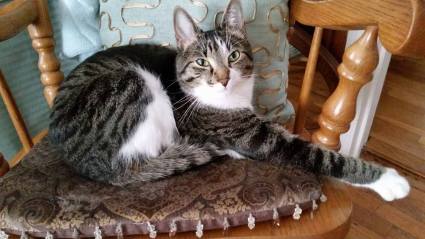
And, of course, my warm and fuzzy thanks to Finny for doing such an excellent job on his very first interview. I hope I can convince him to do another interview in the future (assuming he’ll be willing to forego a nap).

new plant

Come on in! It’s Summer Open House

Standard

Welcome to Frog on a Dime’s first ever Summer Open House! Relax. Kick off those sandy flip-flops, grab yourself a chilled beverage and enjoy.Summer Nick Taught His Cats-cover (1)
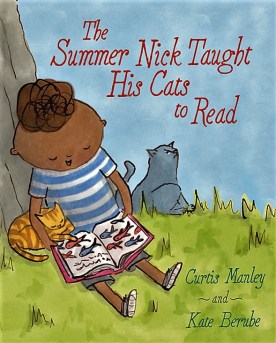
Today I’ll be takin’ it easy too because my feline friend Finn gleefully agreed to skip nap number seven to interview the author of this new cat-centric and summery picture book by debut author Curtis Manley. But first, let me proclaim . . .

I LOVE this book. I had the pleasure–the DELIGHT–to hear Curtis read his droll, charming, sweet, guffaw-worthy story at a retreat in June. This book has so many layers packed between its covers. On the surface, it’s about a book-loving boy and his cats. I mean, the title. There you have it. But it’s also about friendship and meeting people (or in this case, cats) where they are. It’s about opening someone’s world by sharing something you love. It’s about patience. It’s about the glories of imagination and storytelling. It’s about appreciating different learning styles, and yes, it’s about the summer Nick taught his cats to read. Quite a teacher, that Nick.

Enter for a chance to receive your own copy of THE SUMMER NICK TAUGHT HIS CATS TO READ! If you’re already a Frog on a Dime follower, simply leave a comment (OR question for Curtis) on my contact page by Noon (EST) on Sunday, July 31.

OR if you’re new to Frog on a Dime, you can register to become a follower (on the home page) and automatically be entered into a drawing exclusively for new followers. Winners will be announced at Noon on Monday, August 1.

Looks like my furry friend’s ready for you, Curtis . . . take it away, Finn!

cat book 2 (2)Finn says, “Welcome, Mr. M!”

Finn: Thank you for agreeing to talk with me, Mr. Manley. I have so many important things I want to know about you. 

So, for starters, what is your favorite day of the week?

Any day that a cat snuggles on my lap and purrs is a good day. I’m very lucky that that

CurtisManley-Sep2014 web2 (2)

Meet Curtis Manley

happens nearly every day!

You know what? I like you already. Let’s keep going.

If you were a cheese, what kind would you be? Why?

I would want to be any kind of cheese that mice don’t like. Because if I was a cheese that attracts mice, the mice would then attract cats—who would be tempted to jump on the mice (and me) with their claws out. Ouch!

You’d have no worries about me pouncing. I am rodent-intolerant. Ugh. The gas. The bloating. Why is Vicky looking at me like that?

Let’s see, next question:

What is under your bed?

Funny you should ask! Under the bed are boxes. Some of the boxes have things in them, and some are empty. There are just enough boxes to make it impossible for a cat to get under our bed. Why ever would we do such a cruel thing? I will tell you: When we adopted our current cat, Felix, from the shelter, he had already been adopted by two different families—and returned to the shelter by each of them because he hid all the time. So when we brought Felix into our home, we made sure that all the hiding places were where we could still see each other and get to know each other. It still took about a year for him to decide that he doesn’t need to be afraid of us.

So, is it time to let him get under the bed if that’s what he wants to do? Probably. And should we just happen to leave some crayons and drawing paper under there? Yes!

cat book 1

What’s the best gift you’ve ever received?

A few months after my wife and I were married years ago, we gave ourselves the gift of a cat adopted from a shelter near where we lived in California. He was a tuxedo cat who had been able to donate blood to save another cat’s life. He was the sweetest cat, moved with us around the country (CA to AZ to NC to WA), and never seemed upset or jealous when our (human) baby daughter appeared and took up much of our attention. He was with us for more than 12 years. We still miss him.

[Sniffle sniffle] No, those aren’t tears. I got a whisker in my eye. Look away. [Dab-dab with the end of the tail.]

Now, seeing as you are a human, what is your inner adult/inner child ratio?

I prefer to think of it as the inner child/inner adult ratio—because then when the ratio goes up it is a good thing! So: My inner child/inner adult ratio has increased over the past 10 years and is now probably something like 60/40. I suspect that as I write more children’s books the ratio will continue to go up…

I’m more of an NPR fan myself, but if you could make a guest appearance on a TV sit com, which one would it be–and why?

I’ve fallen out of the habit of watching TV, but—and no, this doesn’t date me at all—I could imagine myself as a guest on Gilligan’s Island… I could play either a geologist looking for evidence the island had been inundated in the past by a huge tsunami, or an author (like, for instance, Robert Louis Stevenson) hoping to live in a tropical paradise to regain his health. Personally, I’m in good health; thanks for asking!

Describe your sock drawer in three words or less.

Dark!

If you hadn’t become a writer, what would you be? Please don’t say a dog groomer.

Well, I used to be a technical writer (not quite the same as a writer). Before that, I tested software. And before that, I was a volcanologist (no, that has nothing to do with pointy-eared aliens from the planet Vulcan) and got to explore volcanoes and lava flows in the middle of nowhere. One day in Idaho when I returned from a long hike I found that cows had made big smear marks on my pickup truck by licking off the dust. Cats would never do anything like that!

Felix DSC05932 (1)

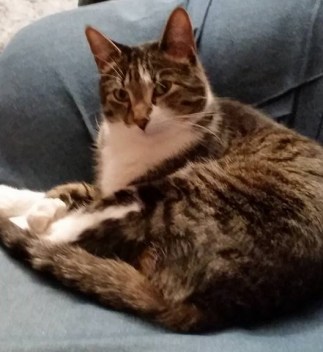
Meet Mr. Manley’s friend, Felix

Speaking of cats, can your cat Felix read?

Felix  is showing some interest in reading, though right now it is only the words on the grocery sacks he loves to curl up on. Learning to read doesn’t happen overnight, so we will keep working with him!

Good luck with that.


For this next part, I’m going to throw words at you like little balls of yarn to see how you respond. Ready? Pounce . . .

Favorite punctuation mark:

I like ellipses (…) but I also like the em-dash (—). To state a preference would be unfair to each of them.

Favorite food or drink while writing:

I enjoy many kinds of tea—except Earl Grey. And I am not a coffee person (my apologies to those who are—but that’s probably not you, Finn…).

You’re right. Coffee is vile. I prefer tepid tap water from the bathroom faucet with one of my humans standing by to adjust the flow. But enough about my charming quirks.

Fantasy road trip destination:

I’d love to spend more time in the Four Corners area: colorful sandstone cliffs, twisty rivers, pueblo ruins, and petroglyphs. Alternative destination (though trying to drive there is a bad idea): Iceland.

Totally hypothetical question: do you think dogs could be taught to read? [giggling]

Of course you know the answer!

Of course. Are you sure you’re not part cat, Mr. Manley?

Finn — Thanks so much for interviewing me for Frog on a Dime! I had a lot of fun answering your questions! When you become famous for interviewing celebrities, I’ll get to boast that I was the first (interviewee, not celebrity)!

The honor was all mine, Mr. Manley. You made my first interview job so easy, but I’m still ready for nap number eight. Valentine Finn (2)
 

I hope everyone will enter to win a copy of Mr. Manley’s picture book. It definitely made it worth learning to read!

 

Thursday, July 28 – Frog on a Dime’s 1st Summer Open House

Standard

holland sunsetJuly’s on the down side of the hot slippery slide and store shelves are already stocked with back to school supplies. Hot cakes! Summer’s evaporating! Now, don’t you pout, my little pup tents, there’s still plenty of summery fun to be had–thanks to the first ever Frog on a Dime Summer Open House!

  • Enjoy a delightful, TOP SECRET (for now) guest author interview–and wait till you see who’ll be conducting the interview!
  • Enter to win a summer-perfect prize (one for new followers and one for faithful follower folks)
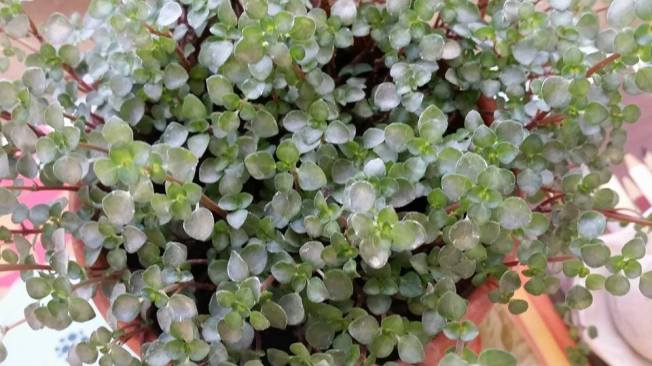
  • Plus, tour Frog on a Dime’s fresh, new look

You won’t want to miss it! See you Thursday, July 28, my little strawberry lemon pops!

I almost wish we were butterflies and liv’d but three summer days – three such days with you I could fill with more delight than fifty common years could ever contain. ~ John Keats


Help You Help Me

Standard
morning glory

Every writer I know is a “waiter.” We wait for our muses to return from Rome. We wait for feedback from critique partners. We wait for emails from editors and agents. We wait for books to launch and reviews to post. For those of us who are pre-published, we wait (and wait and wait) for our first big break into print. Given that waiting is a given no matter where we are in the waiting room, it’s wise to find ways to use the time, well, wisely. Otherwise we’re time-twiddlers in danger of becoming solitary sadsacks. And yeesh, don’t even get me started on those pricey catered pity parties. What’s that? How do I know about pity parties? Well, uh, [insert awkward silence so long you would take a nap in it here], let’s move on.

And so, my little twice baked potatoes, to help each other whilst we while away our waiting time wisely (versus wastely or woely–and sure, those are words (sorta)), here are ways to help yourself by helping other writers:

You’re so smart, my little brownie bites, I bet you already do a lot of these things, but maaaaybe you hadn’t thought about how helping you could help someone else. Hope these ideas help. Can’t wait to hear your ideas too!

  • Join or start a critique group.
  • Offer to exchange manuscripts with someone who writes for a similar age group or genre.
  • Know someone who’s new to writing in your area? Invite them to the next SCBWI event in your area and introduce them around.
  • Send encouraging notes or emails to fellow writing friends. Aim for sending two a week.
  • Promote a friend’s books on social media.
  • Read books or articles on craft–pass along what you’ve learned.
  • Offer to guest blog (even if you have one of your own).
  • Enter a writing contest or apply for a writing scholarship or grant–and challenge a friend to do it with you.
  • Offer to teach a one-day (or even one-hour) workshop for young writers at your local library.
  • Join or start a book club.
  • Read books for fun. When you’re done, recommend to a friend.
  • Study books for craft–how’d your favorite author “do” that? Post ideas on Facebook.
  • Go to book launch events for your friends.
  • Write articles, poems or puzzles for children’s magazines–and encourage a friend to do the same.
  • If you discover a new children’s magazine, encouraging blog or writing opportunity, share it with your friends.
  • Volunteer to read to a class in your local elementary school or senior center.
  • Help a literacy program.
  • If you have a blog, invite friends to do a guest post or do a guest interview.

“For a while” is a phrase whose length can’t be measured. At least by the person who’s waiting. ~ Haruki Murakami

why rabbits play checkers and you can too

Standard


DSC01422

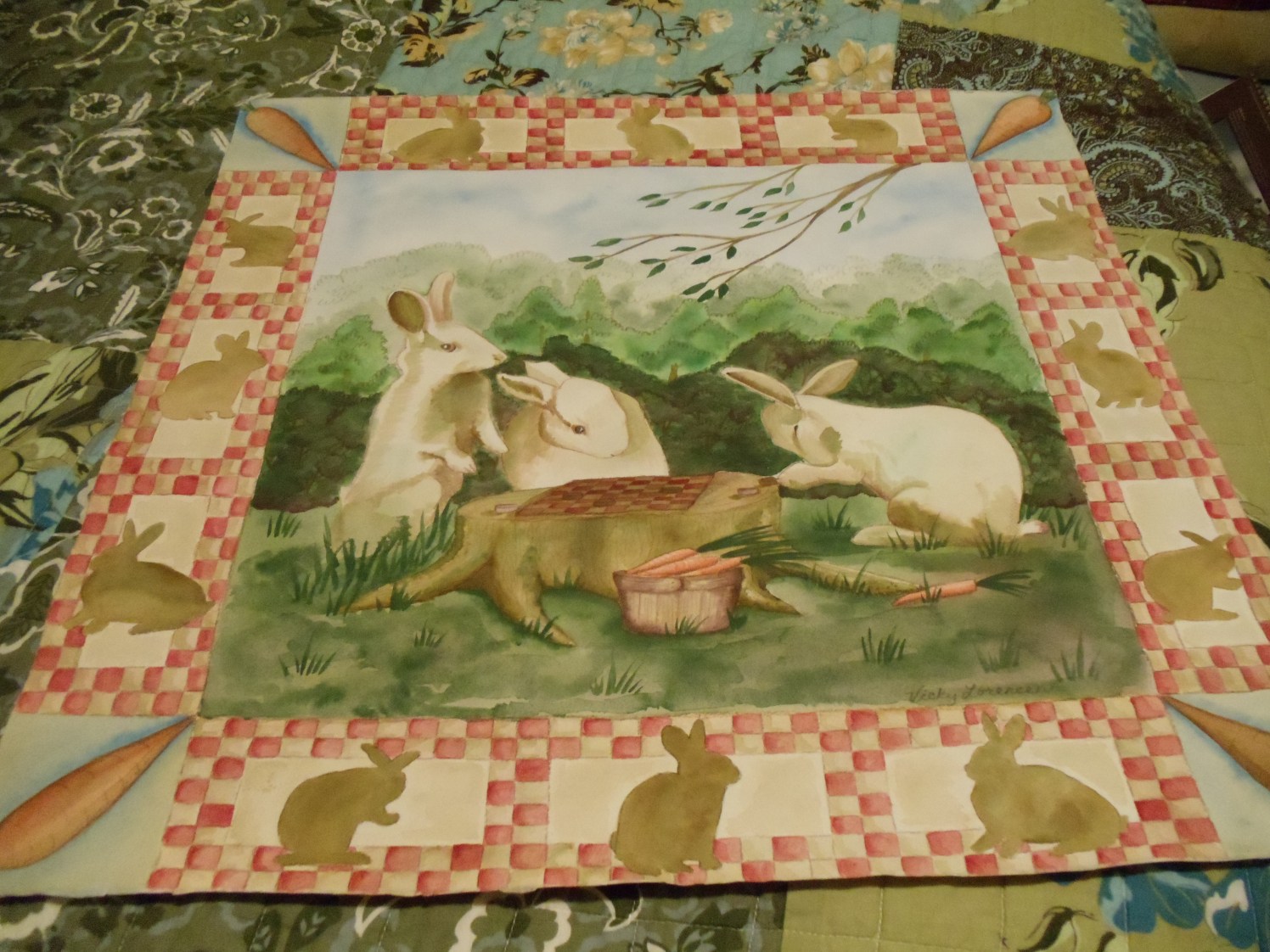
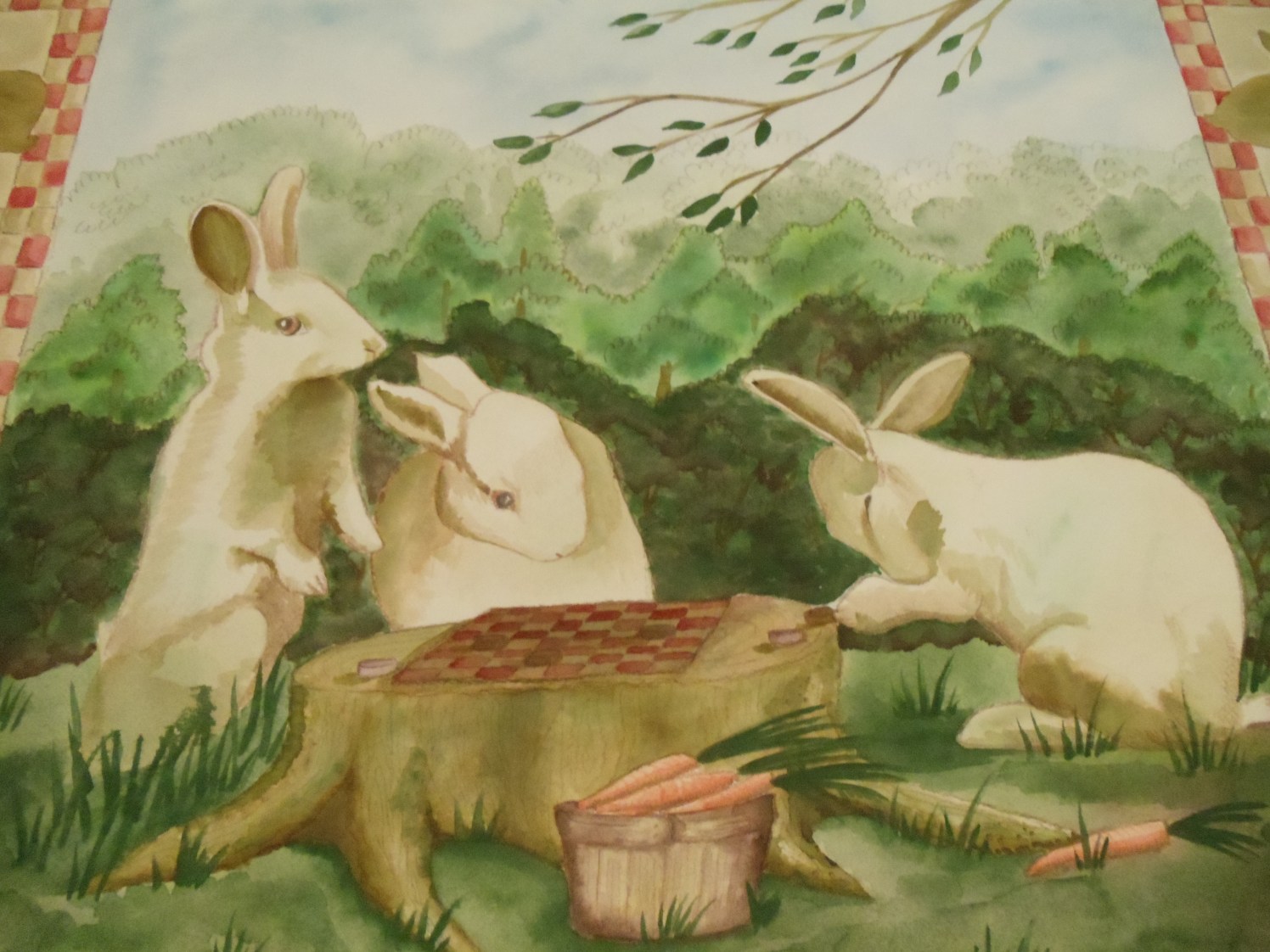
Scooter Plays Checkers, a watercolor by Vicky Lorencen

Ironic, isn’t it. Rabbits eat carrots. Carrots contain vitamin A, a nutrient essential for good vision. With such great eyesight and countless stories starring rabbits, you’d think bunnies would be big on books. Not so. Nine out of ten prefer checkers. Why am I telling you this? I haven’t a clue. But it’s gotten you reading this far, and that my thimbleberry tarts, is what this post is all about.


Scooter Plays Checkers,  watercolor by Vicky  Lorencen

Since I can assume you are not rabbits, given that you’re still reading this, I want to recommend some books you may enjoy exploring this summer. Full disclosure–not of these are new. Regardless, they are worth exploring. And the fun thing is, you can pick them up, graze a bit and come back later to enjoy a bit more.

Right now I’m reading Contagious: Why Things Catch On by Jonah Berger. Jonah is a marketing professor at The Wharton School at the University of Pennsylvania. I admit to being a bit of a psychology and marketing geek, so his book interests me. It also surprised me. As a blogger I was deflated to learn that only about 7 percent of our daily communication takes place on social media. Seven stinkin’ percent! On the other hand, as a writer, I was comforted and motivated to think that means a whole lot of our interactions take place face-to-face and in writing–good, ol’ fashioned writing. This book would be especially valuable to anyone who is in the promotion phase with your book. Or for all of us who want to be ready for when that day finally, finally, sheeeesh-finally comes.

The Mind Map Book by Tony Buzan. This book can teach you how to unleash the creative power of your brain–and you get to color while you’re doing it. Perfection!

Making a Literary Life: Advice for Writers and Dreamers by Carolyn See I’m going to level with you since the chances of Carolyn See ever seeing this less than zip, this book is now 14 years old, so it’s a titch out of step. But there are so many timeless insights, pinches of practical advice–like writing charming notes, and Ms. See’s delightful perspective, you can’t help but love this.

Writers [on Writing] Collected Essays from the New York Times Treat yourself to this treasure. Barbara Kingsolver, Carl Hiaasen, Susan Sontag, Joyce Carol Oates, Alice Walker, Kurt Vonnegut, John Updike, Jamaica Kincaid, Marge Piercy,  Saul Bellow, and so many more . . . it’s like an all-you-can-read author buffet. Great car trip or beach reading.

100

Photo by Vicky Lorencen

How about you? What are you tucking in your beach bag? Share those titles! (But not with bunnies, because you know.)

My computer beat me at checkers, but I sure beat it at kickboxing. ~ Emo Philips

how to avoid the foisting bellybutton-gazing magna nincompoopus

Standard

Photo & Collage by Vicky Lorencen

Photo & Collage by
Vicky Lorencen

You, my lovelies, are brilliant, radiant writers. You are warm and kind, and most days you smell pretty good. But even the creamiest of the crop can slide down the sloppy slope into that abyss of abysmal behavior. How do I know this? Um. Well. Okay, enough about me.

Consider this list of Don’t Do’s and Do Do’s (smirk):

The Foister–you’re at a conference. It’s social hour. A new person walks by. You reach out and touch his arm. He stops. “Here’s my card,” you say. He looks at the card. He looks at you. He looks at the card, stuffs it in his pocket and walks on. Look. Another person approaches. She sees you reaching for a card and does a U-turn. At the end of the night, you see your card left under wine glasses (My card’s not a coaster!) or, worse yet, populating the trash bin. This is not good. You’ve been pegged as a Foister.

What to do: Take your postcards and/or business cards with you to the conference, but use the social time to talk to people. Scary, I know. But you are not an apron-wearing sample distributor for Costco. Your job is not to see how many units you can move by the end of the night. You want to network, make new friends and enjoy. So, when it comes to cards, wait until someone asks you for one. This takes patience and self-control, but it’s the right thing to do. And it’s the most effective way to share your cards. Handing your card to someone who actually wants it is a time honored way to do a bit of networking and build relationships. And for the love of 12 pt. font, don’t forget to ask for their card too! You can do this, my little figgy pudding.

The Bellybutton-gazer–when a presenter asks for questions at the end of her talk, this is not your cue to raise your little pencil grabber and then famble on about how you’re having trouble with your middle grade novel’s subplot because it’s based on your uncle’s dairy farm in Minnesota and you’re afraid of cows, but it’s crucial to the part in the main plot about the twins who own a cow circus and blah-blah-blah . . . NO! This is not good.

What to do: phrase your question in such a way that others could potentially benefit from the answer. Do not ask three more follow-up questions, and thereby monopolize the Q&A session. Wait until everyone has had a chance to ask a question before posing a new, carefully worded question. You can do this.

The Magna nincompoopus–you’re been to every conference, retreat, workshop, book talk and poetry slam in the tri-state area. You read Publisher’s Weekly, weekly. You’ve taken online classes, joined a critique group, and you have your own blog for gosh sakes. So, now you’re at yet another conference. You could practically teach the thing (or so you think). Before you know it, you’re commandeering conversations, over-talking/under-listening and taking condescension to new depths. You’re behaving like a magna nincompoopus.

What to do: set a goal for yourself before you ever leave the house–today I will meet and listen to three new people. I will only offer advice or information, if asked. And, even then, I will be to the point. I will learn three new things. I will be intentional about finding opportunities to encourage others, especially if they are new, or nervous or human. You can do this.

I can do this too. Now, let’s have a cookie.

Never underestimate the power of stupid people in large groups. ~ George Carlin

your bill of writes

Standard

Vicky L. Lorencen's avatarWelcome to Frog on a Dime

Photo by Vicky Lorencen Photo by Vicky Lorencen

In the spirit of Independence Day, I present to you [cue the fife and drum please] . . .

A Writer’s Bill of Rights

You have the right to observe, but not follow trends.

You have the right to seek a second opinion.

You have the right to ask, “What if?”

You have the right to laugh at your own writing. Hey, if you’re funny, you’re funny.

You have the right to leave your beloved critique group if it’s no longer serving its purpose.

You have the right to say no when a friend of a friend asks for feedback on her 1,000-word non-fiction picture book about the history of toe jam.

You have the right not to feel guilty if someone asks for your honest opinion and doesn’t like your response (assuming you delivered the news graciously).

You have the right to try a new genre.

View original post 251 more words

3 tips to master manuscript clutter

Standard

Collage by Vicky Lorencen

Collage by Vicky Lorencen

Learning  to live clutter-free is quite a “thing” these days. How-to books make it sound possible to sort, organize and donate our way to a serene and less stuff-y life.

Maybe we writer types can take a hint from this trend toward simplicity.

My little miniature eclairs, I don’t know if I ever mentioned that I was once a freelance newspaper reporter. I got the fun, fluffy assignments. Right from the start, my editor told me, “Write tight and bright.” I liked that. Tight was easy to understand–watch your word count. But bright? I took that to mean, make sure your writing is not only polished, but also free of, you guessed it, clutter.

Am I master of my clutter? Ha ha ha. Still, please consider these tips to produce manicured manuscripts.

  • Read your manuscript out loud–or better yet, let someone else read it to you. Oh, golly. I’ll warn you. This can be painful, but it will prove to be a productive process. If someone is reading to you, have a copy of your manuscript in hand. You can make notes and circle or edit the repetitive words or phrases you need to extract. (And be sure to offer to return the favor for your reader, or give them a treat, or both.)
  • Use the Find/Replace function in Word to sniff out clutter. We all have crutch words. Mine is “just.” Chances are you have a word “that” you lean on too often as

    Collage by Vicky Lorencen

    Collage by Vicky Lorencen

    well. Find those prosey parasites and pinch ’em.

  • Toss those metaphorical single socks, chipped china cups and empty pens. Systematically review your manuscript, focusing on one of these categories at a time:
    • Purge adverbs. They aren’t the devil (sorry Stephen King), but adverbs aren’t angels either.
    • Pluck passive voice. Again, not the devil, but would you say–The road was crossed by the chicken. Uh, no. Aim for active voice. And smooth elbows.
    • Clip clichés. You have stunning imagination muscles. Flex them. Don’t rely on stale, trite, predictable, yawn-worthy expressions when you can blaze your own trail. Oops. I mean, mow your own path, pave your own lane or carve your own groove.

Okay, my little Word Warriors, remember, you have a mouse trap where your heart should be. You’ve never heard the word mercy. You carry red pens, and you’re not afraid to use them. Now, get out there and clobber that clutter. And then, yes, you may have a cookie.

Out of clutter, find simplicity. ~ Albert Einstein

is your mail box lonely? let me help

Standard

Collage by Vicky Lorencen

Collage by Vicky Lorencen

Japanese author Haruki Murakami said, “How wonderful it is to be able to write someone a letter! To feel like conveying your thoughts to a person, to sit at your desk and pick up a pen, to put your thoughts into words like this is truly marvelous.”

When was the last time you received a letter–a real, old school, uplifting handwritten letter? Other than those long, yearend recaps that some folks send during the holidays, I’m guessing it’s been a mighty long time since a letter landed in your mail box. Same here.

Well, that’s about to change.

Frog on a Dime is all about encouraging writers, so I’d be delighted to pen you a pick-me-up during the month of May. Just leave me a message to say you’d like a letter of encouragement. How easy is that? No strings attached. Just a stamp.

Letter writing can be seen as a gift because someone has taken her time to write and think and express love. ~ Soraya Diase Coffelt

Think you’re not a bully? Take the “Am I a Bully?” Quiz

Standard

Photo by Vicky Lorencen

Photo by Vicky Lorencen

Are you a bully? You’re mostly likely saying no. Well, um, prepare yourself for an awkward moment of self-revelation served cold with a side of I Did Not See that Coming. You’re still skeptical, aren’t you. That’s okay. I’m not going to bully you. I’ll let this quiz do my convincing for me. Please go ahead.  Take this quick, eight-question test. We’ll talk when you’re done.

Pencils ready? Please respond with a T for True and an F for False.

The “Am I a Bully?” Quiz

  1. _____ I encourage my writing friend to invest hours trolling Facebook, especially when I know awards or “best of” lists are being announced so she can look for her name and not see it there.
  2. _____ When a rejection letter arrives, I help my friend dissect it, looking for any nuance that suggests this was a personal rejection and a comment on her chances of ever selling this manuscript in any form, both existing and those yet to be created, anywhere in the known universe.
  3. _____ I help my friend do side-by-side comparisons of her writing journey with that of someone else, all the while posing questions like “How old was he when he sold his first book?” “You know you should be a lot further along by now, right?” “Did you know he writes 9,000 words a day?”
  4. _____ If my friend says she’ll never be published, I affirm her in her fears with a hearty, “You betcha!”
  5. _____ If I suspect my friend may be hoarding Rubbermaid® tubs of jealousy under her chocolate hamper, I am swift to shift into shame mode and toss out words like immature, sophomoric and baby doodoo head.
  6. _____ When my agent-less friend learns one of her friends got an agent, I read and re-read the announcement aloud to her using a fancy British accent. Once it’s tattooed on her gray matter, we move on to making a list of the reasons an agent will never-ever-ever want to represent someone like her.
  7. _____ When my friend complains that all of her ideas are lame, I protest and correct her by saying, I see them as derivative, tired and utterly unappealing.
  8. _____ When my friend compares her rough draft with the edited/polished/published work of her favorite author, I fail to point out the unfair comparison while we drive to the store for more Cherry Garcia.

You answered F on every one, didn’t you.

Photo by Vicky Lorencen

Photo by Vicky Lorencen

But, my dearest buttered English muffin with apricot preserves, you are a bully. Every time you belittle yourself, blame yourself for having human emotions like jealousy or sadness, or torture yourself by comparing your unique journey to that of someone else, you are bullying you. Are you seein’ what I’m sayin’?

For the love of ampersands, stop.

Oh, I know it’s not that easy. It’s not easy at all. But if you can’t be your own defender, who can be? Start today by being mindful of the words you say to yourself. Instead of damning jabs, try using the sweet, consoling, empathetic words you give to others. Seek the company of encouraging people. Go on a 48-hour Facebook fast. Be BIG and send a worthy someone a note of congratulations. Be real about your disappointments. Celebrate even small victories.

And remember, my little former self-bully, even now, you are making some people sick with jealousy just by being you. Now, doesn’t that make you feel better? You betcha!

If you are neutral in situations of injustice, you have chosen the side of the oppressor. If an elephant has its foot on the tail of a mouse, and you say that you are neutral, the mouse will not appreciate your neutrality. ~ Desmond Tutu