Author Archives: Vicky L. Lorencen

Why I can’t write outside my race, I think. Probably.

Standard

Frog 3This is not a how-to.

It is a thought in progress.

This longer-than-usual post is not intended to persuade you to think a certain way. I’m simply sharing my struggle. In full transparency, I do hope it will encourage you to wrestle too.

I am puzzling over the question – how can I, a middle-aged white lady, promote greater diversity in children’s literature? Further, can I personally contribute my own work?

And now my noodle is steaming. Just call me Ms. Ramen Head.

Let me get specific now.

See, five years ago a character came to me while I was at an SCBWI-Michigan spring conference. I was in a breakout session with Donna Gephart. And, this kid, he never moved out of my head.

I LOVE this guy. But as a character, he is a challenge combo (without a side of fries. Darn.)

First, he is a him, but I can handle that. I like writing boy characters best.

He chose a hobby I have no idea how to do, but I can try to learn.

And, finally, he is African American. Yep. That’s where things get complicated. I didn’t decide that about him. It’s simply part of who he is–a significant part.

Now I am capturing his story in a middle grade novel, but I’m facing a few teensy questions. Oh, you know, like:

  • If it’s okay to me to write outside my gender, why not my race?
  • Is it really necessary for this character to be African American for his story to be told?
  • Am I betraying my character if I change his race?
  • If I do write outside my race, what is the potential for causing more harm than good (even with the benefit of sensitivity readers)?
  • If my book is published, what happens when I show up at a school with primarily African American students?
  • As an un-established author, am I prepared to face the elevated scrutiny my story will receive?

To go even deeper . . .

Executive Editor at Dutton Books for Young Readers Andrew Karre posed these questions at a recent SCBWI conference:

  • How diverse is the well of literature I draw from?
  • Why do I want to write a diverse character? In other words, where are the roots of my desire to write this character?
  • Is my only point of engagement with diversity limited to my manuscript?

In the end, all I want to create is a story that’s authentic and engaging. Most of all, I want this kid I love to be proud of the way I told his story. I think I can best do that without pushing myself to do things that will quite potentially hurt my readers and distract them from the story I want to tell. And so, since I have decided not to write outside my race, I think. Probably. I am asking:

  • How can I offer a diverse perspective in a way that’s true to myself?
  • How can I support diverse authors and diverse books?
  • How can I expand my understanding of all that diversity means?

Here’s the part I do know:

  • There’s clueless. That’s sad.
  • There’s clueless about being clueless. That’s dangerous.

I’m “pleased” to say I know that I’m clueless about a lot of things related to diversity, and really, that’s not the worst place to start. It means I need to be humble, and willing to learn, listen and ask questions. That I can do without question.

Mmm. Mmm. Mmm. Won’t you join me, my little Caramel Apples?

If you dare nothing, then when the day is over, nothing is all you will have gained. ~ Neil Gaiman



48 of the most important hours in a writer’s life

Standard

Because your first responder needs to know about this . . .

Vicky L. Lorencen's avatarWelcome to Frog on a Dime

Doodle by Vicky Lorencen Doodle by Vicky Lorencen

There are a plethora of important days in a writer’s life. (Pardon my use of plethora, but it’s such a keen word.) But, in my book, there are 48 hours that stand out from the rest. They are far from the most fun, but a lot hinges on how we choose to handle them.

Day 1 – The First 24 Hours at Ground Zero

You receive a rejection letter or slam into a serious setback. I know there are some who say it’s best to roll with it. Rejection is knit into a writer’s life and there’s no point becoming unraveled by it. I commend you for your ability to be cavalier, but I can’t manage it myself. The times I’ve tried only came back to chomp me. Stuffing the sadness caused tears to erupt at the oh-so-wrong times, so I’m better off taking 24 hours to wallow and be a wreck.

View original post 534 more words

mindfulness and the writer’s mind

Standard

If you don’t mind . . .

Vicky L. Lorencen's avatarWelcome to Frog on a Dime

Photo by Vicky Lorencen Photo by Vicky Lorencen

You’ve heard of mindfulness, yes? Okay, so maybe you’ve “heard” of it, but your understanding is a tad fuzzy. If I give you a link to a delightful introduction via the lovely Anderson Cooper, can I trust you to come back to Frog on a Dime to read the rest of this post? Oh, you know I can never deny you anything. Okay, my little gum drop, have a look.

You’re back! [Trying not to look surprised] So, this mindfulness-ness thing, now you know it’s really about being aware, about being present–about being. Am I a pro at that? Oh, you little snickerdoodle. You do know how to make me chuckle. All I know is practicing mindfulness is a good, life-enhancing thing that I believe can and will enhance my writing (and yes, yours, too).

I came up with a squatty list of ways mindfulness may do…

View original post 189 more words

17 Things I Want to Remember Not to Forget After I’m Published

Standard

signsClinging to the assumption I will one day be published, I am proactively compiling a list of things I want to remember not to forget once the dream toggles to reality. For safekeeping and future reference, I am storing my self-reminder stockpile here.
And sure, you can read them, if you want, my little twice-baked potato.

Vicky, when you become published . . .

  1. Remember not to complain about advances or book signings and other such publishing blah-dee-blah in front of writers who are pre-published. Reflect on what it was like being left out of the conversation or feeling resentful hearing those complaints. For the love of F&Gs, do not be a Diva McWhinypants.
  2. Remember to remain thankful when parts of the publishing process fail to measure up to what you thought they would be. Behind every delicious meal there’s a messy kitchen. You need to embrace both.
  3. Remember writers write. Just because you’re published now doesn’t mean you get to slack off.
  4. Remember to say thank you humbly without pushing away the compliment (should you be so lucky to receive one). You don’t want the person praising you to feel stupid for liking your work.
  5. Remember you are not the first person on the planet to get published. Other important things are going on in the world that have absolutely nothing to do with you or your book.
  6. Remember to give back – to your local SCBWI chapter, to your local library and to your beloved cheering section.
  7. Remember to be sensitive to those who will find your good news bittersweet. You know how hard it was to act all mature and supportive when your insides were turning to macaroni salad over someone else’s big break. Do not apologize for your success, but aim to keep your relationships balanced—it’s not all about you. Even if your friend is trying to pretend like she’s cool with you talking about every interaction with your new editor, give her some air. She can be genuinely happy for you and still hate your guts for a while. Remember how that felt? Your friend is smart and she will process this and you two will be okay. Just don’t push for it to happen. Be cool.
  8. Remember “your” book was a total team effort. Remember to acknowledge the epic efforts of your agent, editor, art director, copy editor, publisher and marketing team who went all in to make your book real.
  9. Remember to let it really soak in. Being a debut author is a big deal and while you hope to publish many more books, this is the one that changed everything and will probably be the most celebrated, so don’t save the party for the future.
  10. Remember not to hover over Amazon ratings and Goodreads reviews. Do you hear me?
  11. Remember no one is obligated to like, much less buy, your book. Do you like everything that’s in print? Okay then.
  12. Remember not to be shocked or disappointed when your launch day comes and the world looks pretty much like it did the day before. Your book will probably not be the first thing people think of when they roll over and hit the snooze button. Crazy, right?
  13. Remember you are still going to deal with rejection, the emotional roller coaster and disappointment.
  14. Remember once you have an ISBN, people will tend to give more weight to your “wisdom,” but don’t let that buckle your common sense. If you don’t know the answer to a question, let’s say on a panel discussion, it’s okay to say I’m still learning and defer to someone with more knowledge.
  15. Remember what people told you about second books and how it can make you freeze up out of fear it won’t measure up to your first book. That’s normal. Thaw out already.
  16. Remember it’s okay to say no. You don’t have to talk to every school group or travel to the far-reaches of Arewethereyet to speak to a five-person book club. You still need to protect time for writing, friending and other -ings.
  17. Remember to set your sights on a new dream. Your first book is not a finish line, it’s the starter pistol.

We are such stuff as dreams are made on, and our little life is rounded with a sleep. ~ William Shakespeare, The Tempest

Congrats to the Summer Open House Super Giveaway Winner!

Standard

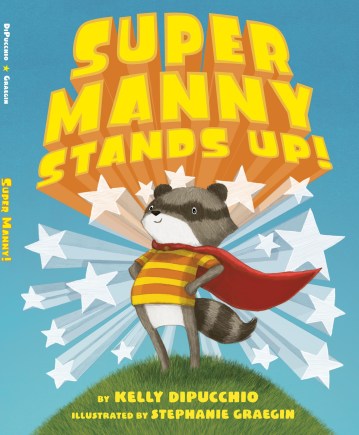
Frog 5Congratulations to ANGELA VERGES, winner of the Summer Open House Giveaway. You will receive your very own autographed copy of Kelly DiPucchio‘s brand new picture book SUPER MANNY STANDS UP! (Angela, please send me your address via the Contact Me page. Then, watch your mail box for your special delivery!)
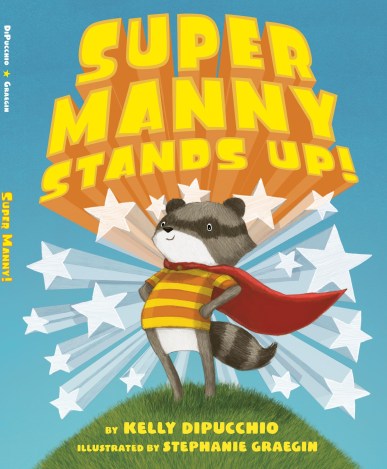
SM_Cover_V2_03

Atheneum Books for Young Readers (July 4, 2017)

Many thanks to everyone who entered the giveaway. Your kind comments were so encouraging. If you included a quote with your comment, you’ll find yours on Frog on a Dime’s new Worth Repeating page. Thank you for sharing!

Special thanks to Kelly for visiting Frog on a Dime, sitting down for a chat and gifting our lucky winner with your book. You are one super lady!

Wishing each and every one of my sweet petunias a splendid summer!

Visit Frog on a Dime any time. You’re always welcome.


Come on in! Summer Open House Presents Kelly DiPucchio & Super Manny! Giveaway

Standard

ALP_9859

My little sparklers, the first time I met Kelly DiPucchio we were at an SCBWI – Michigan conference many years ago. Kelly was wearing a feather boa (not exactly standard issue for children’s writers!) and I thought, “Who is this amazing person?” There are many ways to answer that question–Kelly is a prolific New York Times bestselling picture book author. She is a creative, thoughtful and kindhearted woman. And best of all, Kelly is my friend. I could not be more delighted to have her join us for Summer Open House 2017.

Today, July 4, is the birthday of Kelly’s newest picture book is SUPER MANNY STANDS UP!

SM_Cover_V2_03

Atheneum Books for Young Readers (July 4, 2017)

“This charming story marries the mania for superheroes with a potent anti-bullying message, making it an apt tale for present times. Super Manny, an imaginative raccoon child…declares out loud to the world his own fearlessness and strength in words that children will want to echo…. With great read-aloud potential, this story could be used by both parents and teachers to introduce concepts of courage and standing up to bullies from the youngest preschoolers up.” (Kirkus Reviews, May 2017)

Watch this super SUPER MANNY trailer!

You can enter for a chance to win your very own copy of SUPER MANNY to enjoy yourself or share with a beloved child in your life.

  • All you need to do is leave a comment at the end of this post!
    • Leave a favorite quote to add to the new “Worth Repeating” page, and you’ll get two chances.
    • AND if you become a new follower of Frog on a Dime, you’ll get three chances to win!

Drawing takes place Saturday, July 8 at Noon. 

Lemon sliceSince Kelly was kind enough to stop by for the Summer Open House, how could I resist offering her a seat on the Frog on a Dime porch swing for some lemonade and conversation?


What role has mindfulness and/or intuition played in your writing career?

Mindfulness has played a tremendous role in my writing career and life. I could tell you many stories about how different meditation practices have inspired new book ideas and even completed manuscripts in one sitting. I’ve come to learn over the years that meditation doesn’t mean you have to be in a lotus position on the floor with sandalwood incense and white candles burning. There’s certainly nothing wrong with that and I, myself, enjoy creating those sacred spaces occasionally before I write but I can also create mindfulness by taking walks in nature or sitting in the sun or even folding clean laundry (definitely my least favorite).

What is your favorite day of the week–and yes, why?

Okay, probably only writers and artists will understand this but MONDAY. Mondays mean I’m getting back to my routine and there’s something very empowering and hopeful about having the full week ahead of me so I can get things done. Usually, by Friday, I’m lamenting about how much more I should have gotten done that week!

I know this is rather personal, but what is under your bed?

A few wayward socks (see Question #10), an empty suitcase, stray dryer sheets, a peaceful colony of dust bunnies, a flashlight and copies of A Course in Miracles and Autobiography of a Yogi (for good energy).

Who makes you laugh the most?

A few years ago, I definitely would have answered, “My husband!” However, now I’d have to say my son is closing in on a tie for first place. My husband and I take pride in the fact that we’ve birthed and raised some very funny people.

If you were a cheese, what kind would you be? Why?

I’d probably be Swiss because I’m pale and holy.

What’s the best gift you’ve ever received?

My kids. I know that sounds incredibly hokey and cliché but nothing else in my life can even come close.

Kelly, now be honest, kind of music feels like torture to you?

Heavy metal. That answer should not come as a big surprise to anyone who knows me because I will openly admit to loving Barry Manilow.

What is your inner adult/inner child ratio?

50% Adult. 25% Child. 25% Dog.

If you could make a guest appearance on a sit com, which one would it be–and why?

Probably Modern Family because I love the cast and the show.

Describe your sock drawer in three words or less.

Messy. Mismatched. Merry.

If you hadn’t become a writer, what would you be?

A totally different person.

Your favorite punctuation mark: !!!!!!!!!!!!!!

Favorite food or drink while writing: Coffee!!!!!!!!!!!!!!!

Fantasy road trip destination:

Well, you can’t get there by road but my inner compass keeps pointing me in the direction of Ireland. Cross my pink hearts, yellow moons, orange stars, and green clovers I will get there one day!

Kelly, thank you so much for stopping by. I think you’re super!

And best o’ luck with Ireland!

Be mindful. Be grateful. Be positive. Be true. Be kind. ~ Roy Bennett

Frog 3

For the love of critiques, line edits and proofreading, what’s the difference? I mean, seriously, what is the difference?

Standard

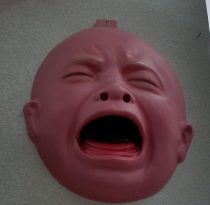
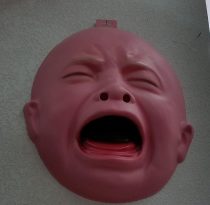
Don’t cry, Sweet Pea. Help is on the way . . .

Vicky L. Lorencen's avatarWelcome to Frog on a Dime

cry baby

Quick–what’s the difference between developmental editing and line editing? What can you expect from a critique? Is line editing the same as copy editing?

Not sure?

Don’t cry, my little rose bud! Help is on the way.

These explanations may give you some clarity and clear up those tears.

Manuscript critique – a critique consists of a compilation of feedback in the form of a letter (typically) regarding  pacing, flow of narrative, transitions, voice, structure and other essential elements of stylish prose. This will provide a subjective view of the strengths and current weaknesses of your manuscript. You typically do not receive comments on the manuscript itself, as with a line edit.

Developmental editing – this extensive type of editing allows you to take a birdie’s eye view of your whole manuscript. With this type of editing, you may receive feedback in the form a of lengthy, detailed letter focusing…

View original post 388 more words

Summer Open House Is Coming!

Standard

Frog 2

Summer is here, my little gooey s’mores. Tis the season for bare feet, blue skies, blazing sunsets and bon fires.

And you  know what else?

It’s almost time for Frog on a Dime’s 2nd Annual Summer OpenFrog 3 House featuring . . .

  • phenomenal New York Times bestselling author (guess who!)
  • Drawings for giggle-inducing giveaways you will love
  • Special opps for new followers
  • And MORE! [insert “oooo” here!]

I can hardly wait!

Okay, I’ve nearly exceeded my exclamation point allowance, so let me simply encourage you to hop on by the first week of July. My little sparklers, you will not want to miss this! (Oops. There I go again! Again!)

And so with the sunshine and the great bursts of leaves growing on the trees, just as things grow in fast movies, I had that familiar conviction that life was beginning over again with the summer. ~ F. Scott Fitzgerald
Frog 7

For the love of critiques, line edits and proofreading, what’s the difference? I mean, seriously, what is the difference?

Standard

cry baby

Quick–what’s the difference between developmental editing and line editing? What can you expect from a critique? Is line editing the same as copy editing?

Not sure?

Don’t cry, my little rose bud! Help is on the way.

These explanations may give you some clarity and clear up those tears.

Manuscript critique – a critique consists of a compilation of feedback in the form of a letter (typically) regarding  pacing, flow of narrative, transitions, voice, structure and other essential elements of stylish prose. This will provide a subjective view of the strengths and current weaknesses of your manuscript. You typically do not receive comments on the manuscript itself, as with a line edit.

Developmental editing – this extensive type of editing allows you to take a birdie’s eye view of your whole manuscript. With this type of editing, you may receive feedback in the form a of lengthy, detailed letter focusing on “opportunities for improvement,” regarding issues such as pacing, flow, transitions, voice, plot, structure, dialogue, character development and more. You may also receive positive observations and suggestions too. Developmental editing does not include the nitty-gritty elements of a line edit.

Line editing – what you have here is the big enchilada of edits, aka “comprehensive editing.” This level of editing, which can vary from heavy to “light” (don’t think fluffy here), consists of a careful combing of your manuscript regarding all of the important elements of fine writing, such as voice, pacing, rhythm, dialogue, character and structure.  Think of it as someone cleaning out the crumbs in your silverware drawer, only in this case, the toaster tidbits pertain to issues like transitions, voice, word choice and character development. You can expect many comments on the manuscript itself.

Not sure about the difference between line editing and copy editing? Check out this helpful article.

Proofreading – the main objective here is to ensure your manuscript is as clean as it can be–free of typographical errors, grammatical gaffs, style inconsistencies or other mishaps that will distract or confuse your reader. This article gives you a helpful rundown on what to expect.

Eventually, every manuscript will need all of these interventions, but for now, take a look at your manuscript and ask yourself what would help you take it to the next level, get you unstuck or unravel a plot knot for you. If you’re a visual learner like me, this chart from Yellow Bird Editors may also help you decide.

[Insert thought bubble here–“Sheesh. Isn’t she going to tell us where to find help?”]

So, my little summer strawberries, where can you get help with your manuscript? (I just had a hunch you’d like to know. ) Sources for critiques and editing are often offered in connection to writing workshops, and are also available via SCBWI, professional services like Yellow Bird Editors or even among your own circle of writing friends or critique group. (And about that last one–if you seek the help of an author/friend–unless you are able to reciprocate in kind–offer to pay them, okay?)

My very best shimmery, summery wishes to you, my talented friends! You can do this.

One day I will find the right words, and they will be simple. ~ Jack Kerouac


take the “am I ready for an agent?” quiz

Standard

Maybe it’s time to take stock. Are you ready?

Vicky L. Lorencen's avatarWelcome to Frog on a Dime

Photo by Vicky Lorencen Photo by Vicky Lorencen
You’ve seen those wedding dress shows, right? A bride-to-be goes on a chiffon frenzied quest for the perfect gown while a group of her BFFs sit semi-circled in the salon, waiting to boo-hoo or just boo over her selection. Once in a while, though, the hunter is simply a bride-wanna-be who is willing to throw gobs of moola at a dress, despite her groomlessness. To me, that seems sad, desperate, and at the very least, poorly timed.

When it comes to writers in search of an agent, sometimes it’s really not that different. There’s a time to focus solely on craft, to learning about the industry, reading and networking. But, if this has not yet resulted in a solid, polished product to sell, why would you spend time looking for an agent to represent you?

Let’s say, however, maybe you’re like me, and you’ve been polishing…

View original post 444 more words