Monthly Archives: July 2014

looking for front stabbers

Standard

Photo by Vicky Lorencen

Photo by Vicky Lorencen

You trust someone, and then you’re stabbed in the back. Hurts, doesn’t it? Ever thought of inviting someone to stab you in the front? Sure, that’d hurt too. But it’d be a constructive versus destructive brand of pain. Okay okay, I know that sounds strange, maybe even a little creepy, but please stick with me for a few more sentences, and I’ll explain as best I can.

See, even though writing by its nature is a solo sport, that doesn’t mean you can’t invite others to join your team. By others, I mean other writers who can give constructive criticism–aka stab you in the front, to hit you where it hurts most–right in your writing.

Losing weight, staying on track with an exercise regime, even cleaning out the garage, are all easier if you have at least one person to come alongside you support, encourage–maybe even push–you. Why should writing be any different? If you’re frustrated with your lack of progress, either in term of pages or improvement, consider opening yourself up to a good, ol’ fashioned front stab.

[At least] three things are certain:

1. Someone pushing you without your permission will only make you want to push back.

2. You need to ask someone to hold you accountable. Nobody volunteers for that job, but most people will say yes if you invite them, especially if you’re willing to reciprocate.

3. You will make better and faster progress with accountability and input, than you will without it.

This is why I am so grateful for my critique group. They’re a friendly bunch of front stabbers who want me to become a better writer and I’m happy to help them do the same.

If you feel stuck with your writing, let me encourage you seek out your own critique group (ask around on Facebook, via your SCBWI chapter list serve or your local library). If a group isn’t already in place, start one. And remember, you don’t have to let geography limit you. Online critique groups can work very well and can include writers from all over the planet, if you like. (I suggest keeping your group Earth-bound. Anything beyond that can get too complicated.) If joining/starting a group sounds like too long of a leap, consider partnering with another writer and setting up a regular schedule for exchanging pages.

Connecting with other writers for criticism and accountability will make a positive difference for you. I promise.

G’head. Take a stab at it.

Photo by Vicky Lorencen

Photo by Vicky Lorencen

As iron sharpens iron, so one person sharpens another. ~ Psalm 27:17

My thanks to Ben Redmond, Director of Student Ministries at the Hub, for inspiring this post. He’s a wise man.

what to do with a “too” idea

Standard

Photo by Vicky Lorencen

Photo by Vicky Lorencen


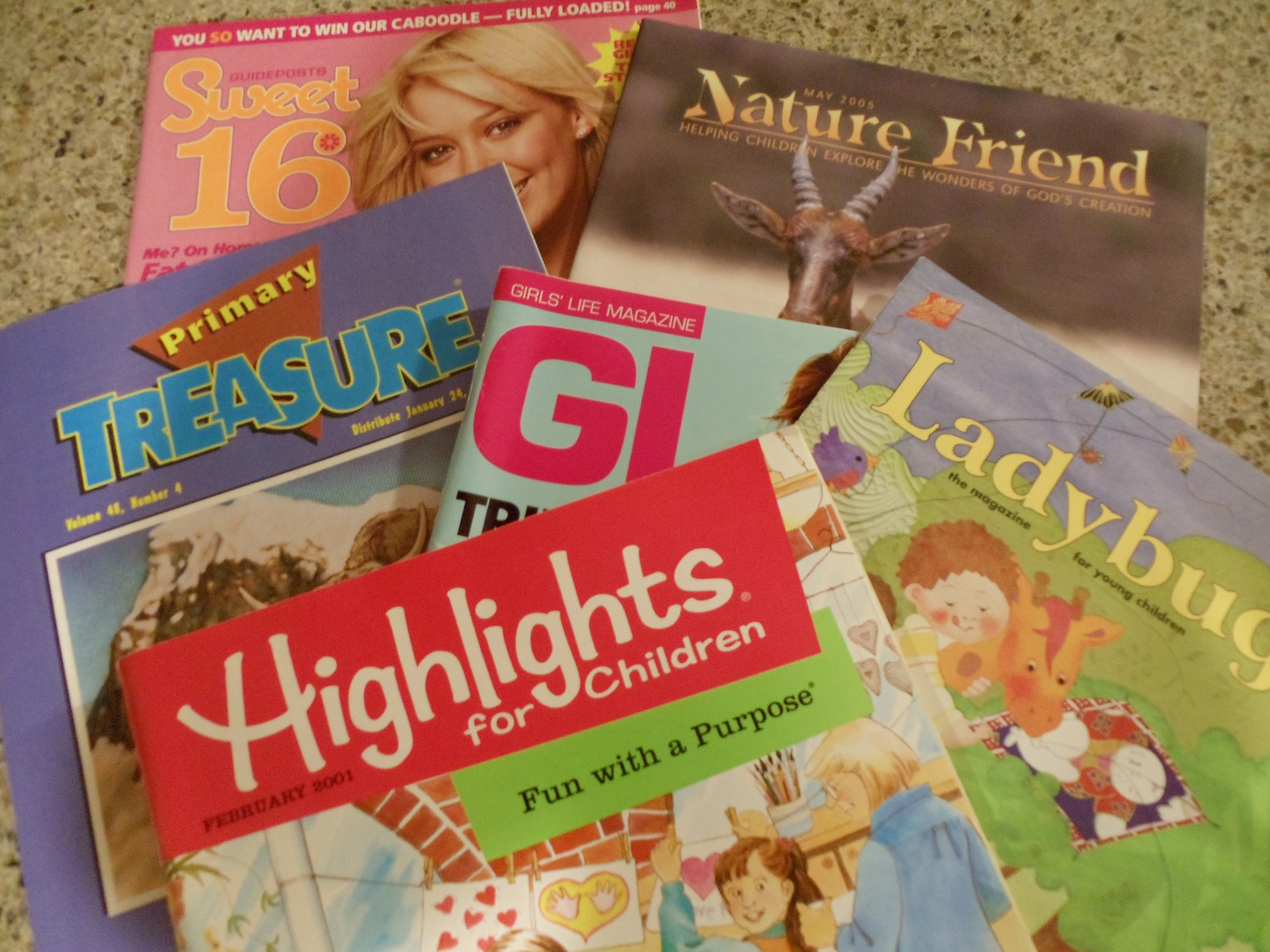
Sometimes I get a niggling, squirmy idea that’s “too” something–too much for a picture book, too little for a novel, but it’s perfect for a children’s magazine article. Magazines–remember those? With so much focus on writing book-length manuscripts, it’s easy to gloss over magazines as a great option for your “too” topics (e.g., giant centipedes, yaks in Tibet, Burmese pythons, sculpting, pillow-making, door-decorating–yes, I’ve sold articles about all of those and more).

For the uninitiated, let me take a swing at answering some common questions . . .

What are the benefits of writing for children’s magazines?
Gaining publishing credits. Wouldn’t you love a title or two (or six) to tack onto your next query letter?
Learning to work with an editor. Without exception, all of the magazine editors I’ve encountered are warm, hardworking professionals who care about craft and not simply compiling enough “stuff” to stuff the next issue. There’s real value in building that relationship.
Seeing your name in print. Now, that’s sexy.
And here’s one you might not expect–you can incorporate tidbits from your research for a non-fiction article to bring authenticity and depth to a novel or picture book. When a character in my first novel needed to do a report for school, I had him do it on the giant centipede. I already had lots of info and it suited his character beautifully (even though centipedes are so creepy!) In my second novel, my main character meets an artist who teaches him how to sculpt–much of what I know about sculpting came from a non-fiction article I wrote for Highlights, which involved interviewing a sculptor.

How do you know what magazines want and how to submit to them?
The research process is very similar to determining which publishing house you’d like to approach with your book. Magazines include submission guidelines on their web sites and by perusing the magazine itself (either online, on the newsstand, in the library or by asking for a sample), you’ll get a good idea of the types of content the magazine would welcome. As with book publishers, be sure to follow submission guidelines exactly.

Is it easier to break into the magazine market compared to books?
Well, yes, relatively speaking. Just think about it number-wise. A small imprint may publish two or three books a year. Larger houses can do far more, but they also get an exponentially higher volume of submissions. This results in stiffer competition for every available spot. Now, consider a monthly children’s magazine. Imagine the metric ton of content the editor needs–articles, stories, puzzles, crafts, recipes, jokes and games–for a single issue. I’ve been a magazine editor in the past, for two different publications, and I remember how much pressure it was to create each issue, given the amount of excellent content needed. The greater the need, the better your chances of being able to sell your work.

What if I have professional quality photos to go with my article, can I send those?
Photos can be a selling point with a non-fiction article. Let the editor know photos are available upon request. For that Highlights article I mentioned earlier, I had photos of the artist and his work, which not only enhanced the article, but my payment as well.

Can I actually make money writing for magazines?
You’d have to be extraordinarily motivated to make a steady income via magazine submission sales. The real prize, from my perspective anyway, is in the publishing credit and the experience. Payments vary widely depending on the magazine’s circulation, the type of article and its word count, and any “extras” you’re able to provide, such as photographs. Once your submission has been accepted, you’ll receive a contract which will spell out your rights and the rate you can expect. One hint–if you have a choice, opt for a magazine that pays upon acceptance versus payment upon publication.

Isn’t writing for magazines going to take away from my “real” writing?
Never, ever, ever make the mistake of thinking, it’s “just” a magazine article. It is real writing. Always send your most sparkling work. If needed, do thorough research and document your sources carefully. Your professionalism is a reflection of your ability, true, but your best writing also honors your reader who deserves your finest. Also, keep in mind, it’s not uncommon for magazine articles to be re-printed at some point. So, avoid viewing articles as “throw away” pieces that are only around a month or two. And thanks to the Internet, they can live indefinitely.

If you have other magazine-writing related questions, send me a message via my Contact Page. I’ll be glad to help if I can.

So, that’s what I do with my “too” ideas. I enjoy doing it, and I bet you will too.

In a magazine, one can get – from cover to cover – 15 to 20 different ideas about life and how to live it. ~ Maya Angelou
the importance of living dangerously

Standard

Photo by Vicky Lorencen

Photo by Vicky Lorencen

I am not a risk-taker, generally speaking. I wear my seat belt, hand sanitizer and sunscreen. Brush twice a day. Eat my burgers fully cooked and avoid stepping on sidewalk cracks.

Yes, I’ve been on the back of a motorcycle (once). I floated in the gondola of a hot air balloon, sat in the front seat of a whirling helicopter, cuddled with a Burmese python, sang an original song to hundreds while wearing a helmet with horns and even walked the streets of Chicago’s north side, but those were exceptions to my usual play-it-safe life. Oh, and once, I even used a public restroom without putting one of those paper doilies on the seat first. So, yep, I guess you could say I’ve sauntered on the wild side a time or two. (I saw you roll your eyes, by the way!)

But here’s what I know: you get what you risk for (or at the very least, you up your chances exponentially).

This spring, comedian Jim Carrey addressed the graduating class of Maharishi School of Management in Iowa. In a rare moment of transparency, Carrey shared how his father had the potential to be professional comedian, but opted to become an accountant because he thought it was the safer choice. It was not. He lost his job.

“So many of us choose our path out of fear disguised as practicality,” Carrey said. “I learned many great lessons from my father, not the least of which, was that you can fail at what you don’t want, so you might as well take a chance on doing what you love.”

Is there a polished manuscript that’s “circling the airport” because you’re afraid of rejection? Submit it.
Is there an agent you want to query? Do it.

Feel the fear, but do what you want to do anyway. You can do this. (And I will join you.)

A ship is always safe at the shore, but that is not what it is built for. ~ Albert Einstein

4 reasons you really mustn’t blog

Standard

Photo by Vicky Lorencen

Photo by Vicky Lorencen

When my cat asked if he could start a blog, I knew it was time to draw the line. Does everybody (and their pet) need a blog? Heck no. And I’ll give you four reasons why . . .

“Everybody’s got a blog.” Uh, no. No, they do not. Not everyone was born to blog. You do not need to add blogging to the long list of things you already feel you should be doing. It’s not as if your mother is harping about how she wants to hear the pitter patter of little blogs before she dies. (But if she is, well, that’s just weird enough to be blog-worthy.)

You’re pointless. It’s my opinion, a blog needs a point of view or theme to give it personality and focus. Don’t have anything you need to say in a blog format? Skip it until you do. Otherwise, you’ll find yourself inventing reasons to post (like the poor sap who has to scrounge for reasons to create yet another inane episode of Keeping Up with the Kardashians). Without a perspective, your blog will feel like a chore and sound like a bore-ing thing. Rats. I was going for a rhyme there and it fizzled. Let’s move on.

Blogging = Vulnerability Now, this isn’t true for all bloggers. I have friends with practical blogs brimming with useful publishing info and writing tools or reviews. (Check out Literary Rambles as an example.) Fabulous! And because of their chosen theme, there’s no need to get too personal. It’s mostly outward focused. But choosing to blog about your own struggles or insecurities (like the times I blogged about jealousy or rejection), means being willing to expose yourself to your readers. That’s scary. If you’re a very private person, those kinds of posts probably aren’t for you.

And there’s another way blogging makes you vulnerable–what if you post and nobody cares? Seriously. What if you pour out your heart or offer a cubic ton of carefully researched info and all you hear is a single cricket chirping (and you’re pretty sure you saw him yawn.) This is not good. This is what we define as a painful experience. You will not like it.

Blogs are time gobblers. I said earlier that blogs aren’t like babies, but they do demand your time and attention. Typically, you’ll need to post at least once every week or so (and sure, “or so” is up to your interpretation and timetable, but you’ll want to be consistent). If you’re already stretched and struggling to find writing time, adding yet another line item to your to do list, isn’t a stellar idea. Personally, I find blogging energizes my writing and gives me a place to share things I wouldn’t have otherwise. But then, that’s me, and I’m an odd duck. So, keep that in mind.

If you’ve visited Frog on a Dime before, you know my intention is to encourage and inspire my fellow writers, so it might seem odd for me to be discouraging you from blogging. It’s just that I want you to think things through and not put unnecessary pressure on yourself. Blogging is not a divine calling or a rite of passage; it’s a way to communicate and use words like “mustn’t” just because you want to.

If you’re thinking of starting a blog, but have some questions, message me via my contact page. I’m not an expert, but I’m glad to share my thimbleful of knowledge with you. And if I don’t know the answer, I’m sure my cat will be more than happy to chime in.

Quick decisions are unsafe decisions. ~ Sophocles