Category Archives: Multipurpose

how to magnitude your gratitude (dude)

Standard

Photo by Vicky Lorencen

Photo by Vicky Lorencen

I love words. Wipe that shocked expression off your face, you silly. You know I do.

This week I found out the word gratitude comes from the Latin word gratia, which means grace, graciousness or gratefulness. To me, grace means receiving something I don’t deserve–it’s that open-hearted expression of forgiveness, the kindness for which I’m unqualified and the willingness to overlook my writer-related neuroses (note the plural). That’s grace to me. And I’m grateful for every little bit I get.

Besides discovering the root of the word gratitude, I also learned from the Harvard Mental Health Newsletter that expressing thanks is strongly and consistently associated with greater happiness (and they have the research to back it up). Gratitude helps us to cultivate positive emotions, relish (and notice!) good experiences, improve our health, deal with the crappy stuff and build strong relationships. KA-pow! Gratitude is powerful.

What was of particular interest to me as a writer was that the researchers at the University of California and the University of Miami used writing exercises to gauge the impact of gratefulness. For example, one group of study participants was asked to keep a log of things they were grateful for over the course of a week. A second group got to list the stuffed that bugged them as the week progressed. The 10-week study not only showed that grateful people felt more optimistic–they were more physically healthy too.

When another group was challenged to write and hand deliver a letter of gratitude to someone who had never been properly thanked for his or her kindness, participants immediately experienced a huge hike in their happiness scores. And these benefits lasted for a month. (That’s better than chocolate!)

Photo by Vicky Lorencen

Photo by Vicky Lorencen

And now [cue drum roll] two sure-fire ways to write your way to happiness and better health . . .

Okay, okay. I know what you’re thinking. This is starting to sound like an infomerical for a self-help seminar or something. Not to worry. I’m sharing these ideas because, well, we writers are not always the most healthy people–physically or emotionally. We get discouraged and depressed. We fret. We are self-critical. And we sit on our bums a lot writing. Our bods and our brains could use a boost, wouldn’t you say? So try these ideas . . . (C’mon. You can do it!)

Write. Send. Repeat. Send someone a good old-fashioned written thank you note. Not an email. Not a text. A “real” note scribed with your own sweet little grabber. Don’t wait for someone to do something nice or give you a present. Pick a person you appreciate and then write to tell them why. It’s that simple. You will feel good and they will feel great. Why, you’ll knock their stinkin’ socks off! Your words carry positive energy. (Who knows, researchers may learn they contain fiber and anti-oxidants too!) Write and send a thank you note once a month. Pick a date you’ll remember–pay-day, your birthday or whatever, and then make it a habit.

Journal Good Stuff. Start by writing down three things you’re thankful for. It can be ANYTHING–the barista made my coffee just the way I like it, I got to work on my favorite writing project this week, my allergies aren’t acting up. You can build from there. Add one more thing each week. As the weeks progress, you’ll be more mindful of the good stuff and be excited to add it to your list. Bonus benefit–because you are cataloging these positive things, you can go back and reread your list for encouragement when life feels sucky. So, there’s that.

And just so you know. I’m grateful for you. No, really I mean it. Now stop reading this silly blog and go find a pen and paper before you get distracted. You’ll thank yourself for it.

Let us be grateful to the people who make us happy; they are the charming gardeners who make our souls blossom. ~ Marcel Proust

the one thing I never think about when I’m editing

Standard

Photo by Vicky Lorencen

Photo by Vicky Lorencen

Maybe you didn’t know it (and maybe it doesn’t show), but in addition to being a writer, I’m an editor. Part of my job as a Communication Specialist is to edit other people’s work. I think about a lot of things when I’m editing, but I guarantee you there’s one thing I never think about . . .

Let me backtrack a sec. Just so you know, there are a lot of things I do think about when I’m editing a piece of non-fiction. For my job, I pour over articles, letters, brochures, ads, scripts and the like. Here are the kinds of questions I ask myself during the editing process:

Who’s the audience for this piece?
What’s the bottom line—the message—to be conveyed?
Does this truly communicate the message or is it a lot of pretty words strung together?
Is there a simpler way to say it?
Could this be tighter? Is there fluff or useless repetition or verbosity . . . (oops, now I’m doing it!)
Is this the best format for this piece? Would subheads help, for example?
Is there a flow and connection throughout?
Is the tone and language appropriate to the message and the audience?
Is there proper use of grammar and punctuation?

Quite a list, isn’t it? So, what “don’t” I think about? I do not think about the author. Hold on. I should be more specific. Maybe it sounds heartless, but I don’t think about the author’s feelings. Sure, when I’m editing, I do try to keep the author’s intent and style in mind. I don’t want to edit to the point that the piece no longer sounds like the author. But as I’m editing, the last thing I care about is the author’s feelings. It’s not even part of the equation.

Here’s what I care about: answering my list of questions above to the best of my ability so that the end product is a clean, eloquent, effective piece of communication. That’s it. I never once ask myself if it would hurt the author’s feelings if I take out an entire paragraph or reorder the piece or change silly things like utilization to a perfectly fine, simpler word like use. And even though that might sound cold, it’s truly a marvelous thing. Think about it–would you rather have your byline attached to a solid piece of writing or a so-so piece? C’mon. Let me hear you say it. Mm-hmm. I thought so.

Why am I telling on myself? I want you to remember this the next time your work is edited or you’re swirling in a vortex of editor comments. Your editor isn’t heartless. Your editor wants to make your work shine. And sometimes that means hauling out the sandblaster and pick ax. It can be painful at the time. But, baby, it’s for your own good. So, try not to take it personally. It really isn’t about you. It’s about making your work better. And what’s not to like about that?

Just don’t touch “my” work!

Editing should be, especially in the case of old writers, a counselling rather than a collaborating task. The tendency of the writer-editor to collaborate is natural, but he should say to himself, ‘How can I help this writer to say it better in his own style?’ and avoid ‘How can I show him how I would write it, if it were my piece?’ – James Thurber

the downside of being colorblind

Standard
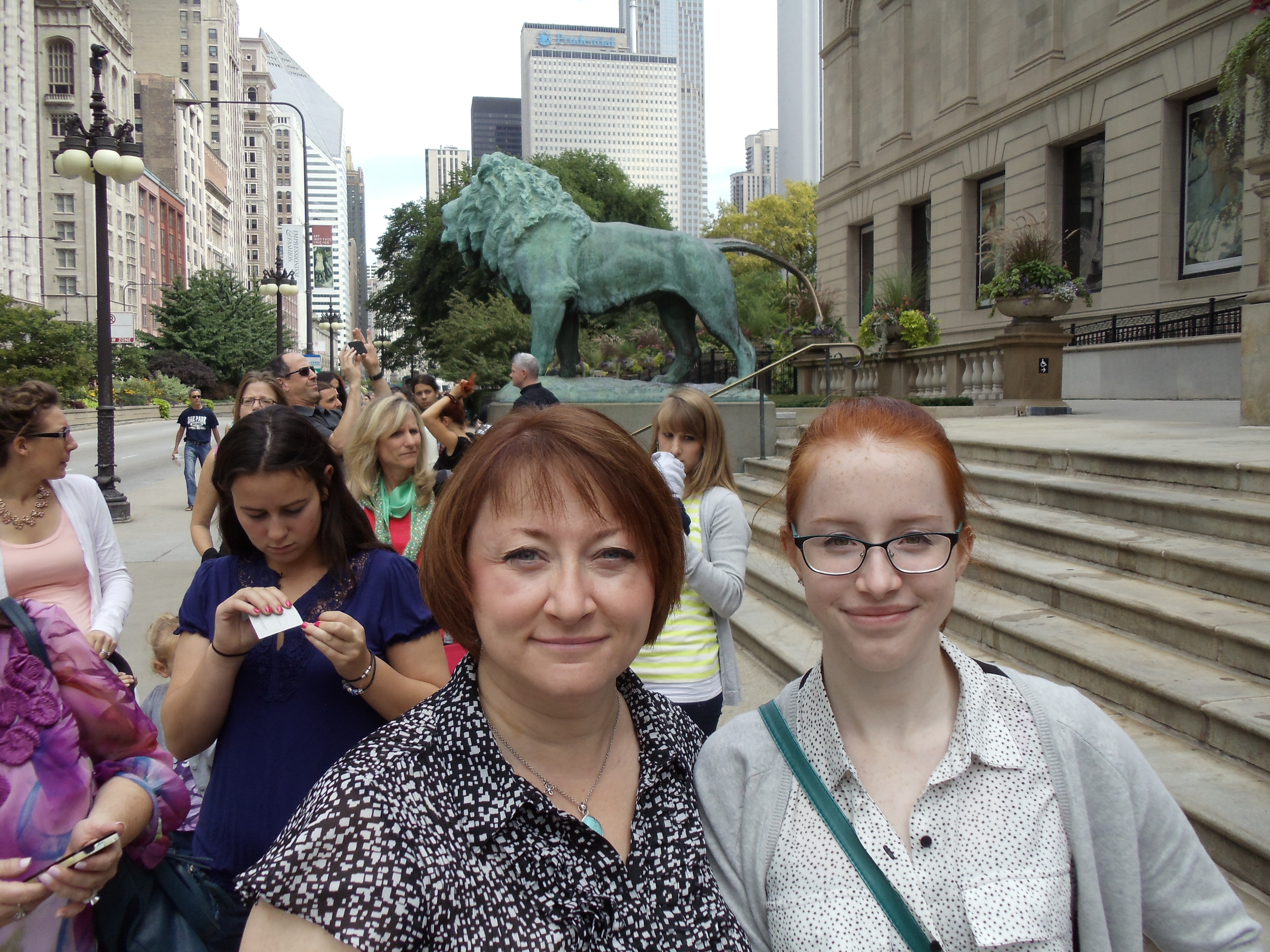
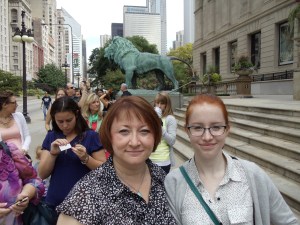
My daughter and me in Chicago

My daughter and me in Chicago

During a recent trip to Chicago, my daughter and I were walking outside the Art Institute of Chicago when she observed, “English is the language I’m hearing the least here. It’s refreshing.”

Now hold that thought, and please indulge me for a minute as I hop down a rabbit trail. (I promise it’ll make sense, eventually. Well, maybe promise is too strong a word. Let’s just say I hope it will make sense.)

When I was a kid growing up in the 1960s, I was fortunate enough to attend an interracial school. Perhaps because of the heightened racial tensions we were experiencing in American culture at the time, our teachers made a point of helping us little white kids to appreciate “colored people” and even taught us Negro spirituals like “Rock My Soul in the Bosom of Abraham.” (At the time I assumed the song referred to Abraham Lincoln!)

I recall being encouraged to understand that we are all equal and all alike inside. In my childish mind, I took that to mean, people may come in different colors, but inside we’re all the same–a white person like me. I also took it to mean that a person’s color was something I was to pretend I did not see.

Now, I’m guessing you learned better than that long before I did.

But as an adult, thankfully, I do see things–particularly people–differently. I still believe we are all equal and that as humans we share many common aspirations, insecurities and needs. But it took me longer than I’d like to admit to come around to the dangers of ignoring a person’s race, or more importantly the culture associated with it. White people like me seem particularly good at making this mistake. We act like we don’t see a person’s color or race, when of course, we do. Just like people of all races “see” others who are different from themselves. For whatever reason, we see this “not seeing” as a good thing, as if being Asian or white or hispanic or black is an unspeakable impediment to be tolerated or ignored. But a person’s racial heritage and color is not something to overlook like it’s a flaw; it’s something to be esteemed and celebrated.

And so, that brings me back to my daughter’s comment about finding it refreshing to be surrounded by different languages. (We live in a very homogeneous part of the Midwest, so while I was pleased about her observation, I wasn’t exactly surprised!) It made me think about the stories I’m creating for young readers her age and a bit younger. How often do I include a character who’s outside my white, middle class world? How can I help kids understand the importance of appreciating people inside and out?

How about you? Do you lean toward the familiar or do you intentionally branch out to create characters that reflect a broader worldview or culture or color? Let me encourage you to think of ways you can enrich a young reader’s world–or make it refreshing, as my daughter would say–by incorporating more diverse characters in your story.

Please don’t misunderstand me, I’m not asking you to change a main character’s name from Pete to Pedro, and call that “diversity.” You know better than that. I’m simply suggesting that when it makes sense, or maybe even when it doesn’t initially, consider how you can build richer worlds for your readers by word-painting with all the colors.

I promise I’ll do the same.

Thinking is the hardest work there is, which is probably the reason why so few engage in it. ~ Henry Ford
ding! ding! ding! we have a winner!

Standard

By Stephanie Stouffer

By Stephanie Stouffer

Heaping thanks to everyone who helped me celebrate Frog on a Dime’s six month anniversary by entering the super lightening prize drawing. I truly, truly appreciate your feedback and kind words!

And now, for the big reveal . . . the winner of a surprise care package filled with YA ARCs, cool office supplies and a personal note of encouragement compliments of Frog on a Dime is . . . Charlie Barshaw! Congratulations! Please provide me with your home address, Charlie, and I’ll have that package on its way to you faster than a frog hoppin’ off a dime.

Can’t wait to celebrate Frog on a Dime’s first birthday with all of you!

Oh! One more thing! Remember to be watching for a fun and intriguing interview later this month with one of my favorite debut YA authors . . . her name is . . . noop . . . not telling yet!

A winner is someone who recognizes his God-given talents, works his tail off to develop them into skills, and uses these skills to accomplish his goals. ~ Larry Bird

celebrating frog on a dime with a prize drawing

Standard

By Stephanie Stouffer

By Stephanie Stouffer


Can you believe Frog on a Dime is six months old already? Frog on a Dime exists to encourage writers, but you all encourage me too! To thank all of my visitors and faithful followers, Frog on a Dime is offering a special PRIZE DRAWING.

Here’s what you need to do: Hop on over to Frog on a Dime and leave a comment on today’s post. Please let me know what you like about Frog on a Dime, what you’d like to see more of (or less of) and/or how I can make my blog even more encouraging to you. (Sorry Facebook comments do not qualify. I love them, but they won’t count for this drawing.)

On Monday, June 3 at Noon, I will select a name at random from the folks who’ve commented . That lucky person will receive a surprise care package filled with young adult novel ARCs, cool office supplies AND an encouraging personal note from me.

What are you waiting for? Get hoppin’!

Oh! And there’s one more Frog on a Dime way to celebrate in June . . . be watching for an interview with one of my favorite debut YA authors! Can’t wait for you to meet her!

I’m not a diva. I’m a tadpole trying to be a frog. ~ Tony Braxton

three cheers for cheerleaders

Standard

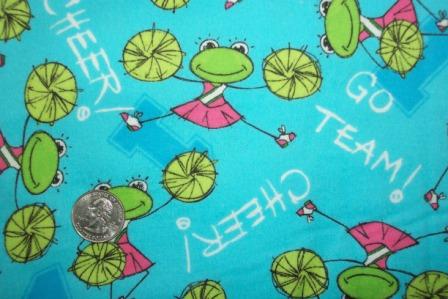
Frog fabricHere comes a shocker: I was never a cheerleader in high school (or college for that matter). I know. I know. Truly mind-boggling, isn’t it?

Truth is, I never really cared about being a cheerleader, at least not when I was younger. But now, here I am at age 50, wanting to be a cheerleader. Now, I don’t mean the teensy skirt wearing, pony tail swirling, pom pom shaking variety. I want to be an encourager. That’s really why I started “Frog on a Dime” in the first place, to be an encouragement to writers like me who could use a boost now and then (and by “now and then,” I mean most of the time!)

If anyone on this planet can appreciate the power of an encouraging word, it’s writers, wouldn’t you think?

Who in your circle of writing friends could use a word of encouragement from you? Go ahead. Make a list of your top three. I’ll wait.

1.

2.

3.

Okay, that’s a great start!

What could you say to them this week that would empower them as they pursue publication? What words would help to unstop their writers block or bolster their confidence to start fresh? You have a lot of power as a writer. Channel it. Use it to make someone’s way brighter. You know what supportive words have done for you. Pass it on.

Let me encourage you to send that text or email or handwritten note today. It’s never too late to be a cheerleader.

Our chief want is someone who will inspire us to be what we know we could be.― Ralph Waldo Emerson

a “highlight” of my writing career

Standard

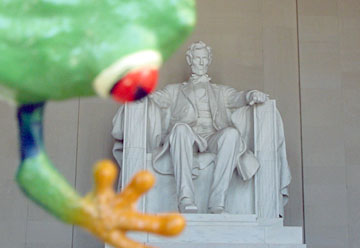
Lincoln with frogHighlights for Children is the gold standard for children’s magazines. Little wonder I’m thrilled see my article “Sculpting a President” in the February 2013 issue. The article was actually written and sold back in 2008, but it’s been worth the wait to see it in print.

“Sculpting a President” shares the true story of how Michigan sculptor Anthony Frudakis created a larger than life size statue of Abraham Lincoln for the Liberty Walk on the campus of Hillsdale College. How fascinating to learn about Tony’s process starting with in-depth research, then on to sketching, followed by creating miniature versions before finally “building” the actual masterpiece. It’s not unlike the steps a writer takes to first investigate, then brainstorm, and then draft character sketches before attempting to craft a larger piece of work. It takes patience with yourself and with your medium, but when you find joy in that process, it makes it worthwhile.

My thanks to freelance reporter Monetta Harr for sharing Tony’s story (and mine) through the Jackson Citizen Patriot.

It may have taken “four score and seven years” to see this story come to light, but I trust it’s here at the right time in our history. Who knows what young reader may be inspired to follow in Tony’s creative footsteps.

My best friend is a person who will give me a book I have not read.― Abraham Lincoln

repeatable one-liners

Standard

Frog-sit-read

You may noticed that I love a good quote. (G’head. Quote me on that.) The SCBWI national conference in New York was a glistening “quote mine,” thanks to the line-up of stellar authors, illustrators and publishing leaders. What an irresistible opportunity to add to my quote collection.

Allow me to share some of my favorites with you:

“Reinvention is the dark chocolate in the writer’s life.” Author Jane Yolen

“Ultimately, the purpose of storytelling is to remind us of something ordinary or familiar.” Author and Illustrator Shaun Tan

“You may own a story’s copyright, but you do not own its meaning.” Author and Illustrator Mo Willems

“I have absolute faith that stories are essential to childhood and society as a whole.” Author Margaret Peterson Haddix

“Be a filter, not a spigot.” Author and Illustrator Mo Willems

“As writers we validate what it feels like to be a kid.” Editor Molly O’Neill, Katherine Tegan Books/HarperCollins
Oh, okay, here’s another from Mo Willems . . .

“Ideas are not animals to be trapped. Ideas are gardens. Some sprout and some are invasive weeds. You’re always planting, every day.” Mo Willems

Seriously? Alright. Just one “Mo” . . .

“Writing is reductive. Writing should be like a sale at the GAP–it should always be 20 percent off.”

Seems like a good place to stop.

Have a favorite quote? Please pass it along.

[A] quotation is a handy thing to have about, saving one the trouble of thinking for oneself, always a laborious business. – A.A. Milne

(Hey, wait a minute . . . )

behold! I bring you tidings of great joy

Standard

Yippie!

Yippie!

Upbeat. Healthy. Incredibly strong.
When was the last time you heard those words associated with children’s publishing?

Sure, you’re skeptical. But I heard those encouraging words with my own ears at the SCBWI national conference in New York just a few days ago. A panel of booksellers, including representatives from some wee little companies you “may” have heard of—Scholastic and Amazon—were asked to share their diagnosis of the current health and well-being of children’s publishing.

Jon Fine of Amazon described ours as a “time of great opportunity.” As books become more accessible through a variety of platforms, he thinks the market is “incredibly strong and getting stronger.”

Scholastic Book Fairs National Sales and Program Manager Bob Brown said he is “very upbeat about what’s happening with children’s publishing.”

Mary Brown, owner of Books, Bytes & Beyond, a children’s specialty bookstore located just outside New York City, described the school and library book markets as “very healthy.”

Lin Oliver, Executive Director of SCBWI, observed that we weren’t hearing comments like these five years ago. It seemed like we’d all turned into Chicken Littles clucking, “The sky is falling.” Or maybe we just got chicken.

But now it appears that the sky is clearing. So, what does this good news mean for you and me?

We need to be upbeat, healthy and incredibly strong ourselves. It means we need to be nimble, flexible and adaptable so that we are ready to take advantage of the new opportunities coming our way.

There’s hope on the horizon. Let’s celebrate by writing and reading and creating!

When a great moment knocks on the door of your life, it is often no louder than the beating of your heart, and it is very easy to miss it. ― Boris Pasternak