Category Archives: Encouragement

how to “get lucky” in five easy steps

Standard

DSC03024
If all it takes to sell a book is talent, work hard and perseverance, more of us would be published. Like it or not, luck is a piece of the process. But can you make your own luck? I think so. You just have to be willing to ask for it, compete, put out, flaunt a little and sell yourself.

1. Ask for it. Whenever I receive a manuscript critique from an editor or agent, I always end the conversation by asking if I can send him or her my manuscript. Pride is too pricey. Go ahead and pop the question the editor or agent is expecting you to ask. (And then make sure you follow through. Send that manuscript and mention the invitation in your cover letter.)

2. Put out. Sweetie, shyness is simply out of your price range. You really must interact with other writers and members of the publishing community via social media. Send cards. Build and cultivate a blog or web site. Comment on other’s blog posts. Be generous and offer your help to others in the form of critiques or feedback. Aside from surrounding yourself with a supportive community of talented people, you never know where those connections may lead.

3. Flaunt a little. Humility is pricey too. You’re going to have to loosen up and show off a little. An author/illustrator friend of mine, Ruth McNally Barshaw, was contacted by an agent after a friend encouraged her to share her sketches online. Ruth wasn’t looking to lure an agent, but posting her work resulted in the start of a fabulous partnership and the launch of her graphic novel series–Ellie McDoodle.

4. Be willing to compete. When was the last time you entered a writing contest? In 2012, I entered a contest sponsored by the National Association of Elementary School Principals. Did I win? Uh, noop. But my picture book manuscript placed in the top 5 out of more than 750 entries. Did that boost my confidence. Yes, indeedy. Children’s Writer and Highlights run themed contests regularly.

But don’t limit yourself to writing contests. If there’s a pricey conference you want to attend, chances are there’s a scholarship contest to go with it. I have had the privilege of receiving funds for both a regional and a national SCBWI conference, as well as for a Highlights Foundation Writers Workshop. And don’t assume you have to be penniless to apply. Check out the requirements to see if you qualify and go for it. Even if you don’t win, oftentimes filling out the application gives you great practice for a query letter or synopsis. So, it’s time well spent even if it doesn’t result in cash.

5. Sell yourself. Have that elevator pitch memorized. Be ready to talk intelligently about whatever you’re working on right now. Know how to introduce yourself as a professional–including a beautiful business card. Work it, Baby.

Make yourself some good luck this week!

Luck is what happens when preparation meets opportunity. ~ Seneca

You know, Hobbes, some days even my lucky rocket ship underpants don’t help. ~ Bill Watterson, Calvin & Hobbes


say hello to lisa rose

Standard
Meet Lisa Rose

Meet Lisa Rose

It’s my delight to introduce you to vivacious, rap-writing debut author Lisa Rose. I first met Lisa through our regional chapter of SCBWI and was immediately attracted to her bright smile, energy and enthusiasm. And wait until you hear her good news . . .

Tell us about your book–details! We want details!
SHUMLIK PAINTS THE TOWN will be published by Kar-Ben in 2016. It’s about a painter named Shumulik who needs to create a mural for Yom Ha’atzmaut (Israeli Independence Day). He can’t think of anything to paint and soon all of Jerusalem will be there. What is he going to do? It has a funny surprise ending!

Can’t wait to read SHUMLIK PAINTS THE TOWN and find out what the surprise is. So, when did you know you wanted to write for children?
It sounds cliché, but I was in second grade. I wrote a poem and my teacher called me a writer. I always wanted to write. But my mother told me to do something that made money. So I became an elementary teacher and got really, really, really rich! Moral of the story: don’t listen to your mother.

Very funny, Lisa. Now, what is it about writing for children that appeals to you versus writing for adults?
Hope. All children’s book must end in hope or by definition they are not a children’s book.

What’s the best writing advise you’ve ever been given?
I was a playwright before I wrote for kids, but this still applies: “No amount of sequins can save a bad script.”

Love that. And it definitely applies to children’s writing too. As you know, Frog on a Dime is all about encouraging children’s writers, so what’s the most encouraging thing anyone has ever said to you (related to writing)?
It was from Michigan’s own Debbie Taylor. I was writing outside of my race and shared with her I wasn’t trying to be revolutionary, I just wanted to write about something that touched me. Debbie said, “That’s your answer!” Recently, I was working on a project and it just wasn’t working. I tried and tried. Until I realized I was writing it for all the wrong reasons. I think good writing must have passion and purpose. The idea must scrape your soul.

Photo by Vicky Lorencen

Photo by Vicky Lorencen

What advise would you give to someone who has been pursuing publication for a long time, with close calls, but no contracts?
Keep going and learn how to flip-turn. I was swimmer before I was writer. It is excellent training. I was used to going as fast as could into cement walls. Instead of crashing after rejection, I just turned around and swam as fast I could into another cement wall. I sent the editor at Kar-Ben over twenty stories. We were on a first name rejection basis. But she kept encouraging me to send more stories. And so I did. I told myself I was going to keep writing until I got a contract or a restraining order from her. Luckily for me, the contract came first.

That’s great advise, Lisa. I’d never thought about flip-turns, but that’s a perfect analogy for the submission process. Time for one last question? Okay, name three things we’d be surprised to learn about you.
1. While I have this nice Jewish book coming out with Kar-Ben, most of my novels feature African-American characters and I am working on a digital media project with the former producers of rapper Eminem. Yes, I even write rap music.
2. I have partnered with a Detroit graffiti artist, Fel3000ft. to create a chapter book. I joke that I write everything from shalom to shazizzle!
3. I like eating ice cream with a fork.
4. BONUS! I have an e-book coming out with MeeGenius in the Spring: OH NO! THE TOOTH FAIRY BROKE HER WING! It is a sequel to OH NO! THE EASTER BUNNY IS ALLERGIC TO EGGS!

Hey, this was fun, Lisa. Thank you for stopping by Frog on a Dime. Wishing you many more publishing success stories. Keep doing those flip-turns!

a power of incomparable worth

Standard
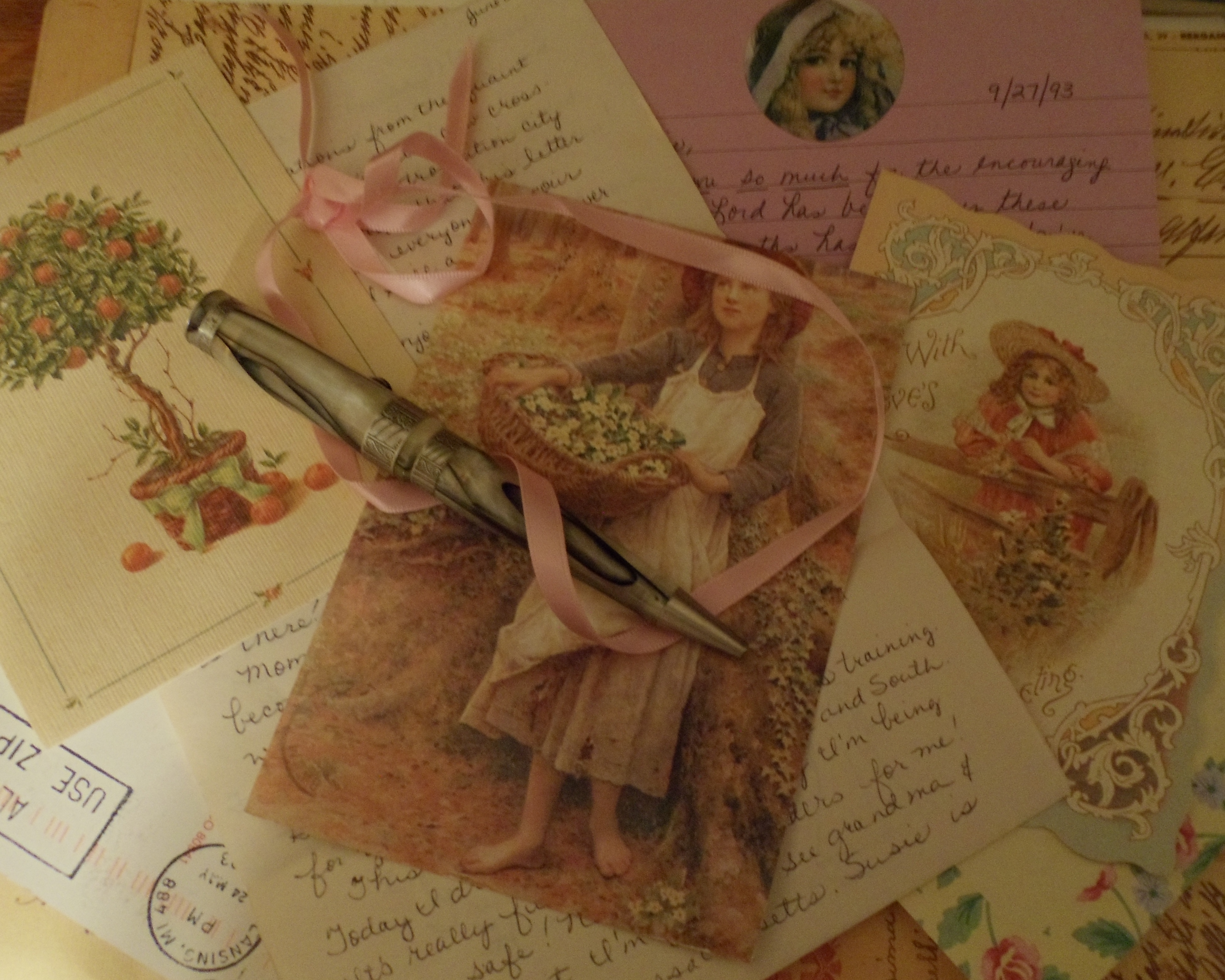
Photo and notes by Vicky Lorencen

Photo and notes by Vicky Lorencen

“Handwritten letters are more special. They’re heartfelt,” my teen daughter said. “They aren’t like texts. You want to read them over and over.”

Such a brilliant girl. [Mom blushes.] She recognizes the power of the written word–the handwritten word.

Eons ago I sent letters to a friend during a dark time in her life. But, to be honest, I had forgotten all about them until I received a surprise in the mail last week. My friend wrote to tell me, “Your loving, tender words were part of the life-saving medicine that kept me alive until I felt like living again.” Wow. I was clueless to the impact of my letters. Incapable of mending her broken heart or fixing her circumstances, all I had to offer were words. And so I did.

Inside her letter, wrapped in a pink ribbon, my friend tucked some of the more the two dozen letters she’d received from me and kept all these years. (See photo.) She said she wanted to return my words to me. How unexpected and exceptional! Re-reading those letters I’d penned ages ago made me grateful to know I was able to do something for a friend in need.

Words are free. Most anyone can draft a sentence. But it takes a willing writer to string those words into something meaningful and soul-touching. You have that ability. It’s a power of incomparable worth.

Whose life will be better because they received a word from you?

Take 20 minutes right now–less time than it takes to watch a sitcom–and write a letter to someone. Don’t fret over revising, critiquing, scrutinizing and all that jazz. Just let your heartfelt words flow. Then address that note, stick on a stamp and send it on its way.

Do it. Don’t delay. Exercise your power today.

To write is human, to receive a letter: Divine! ~ Susan Lendroth

making nice with the colonoscopy of the literary world

Standard

Photo & Collage by  Vicky Lorencen

Photo & Collage by
Vicky Lorencen

Be look-me-straight-in-the-eye honest . . .

If Synopsis sent you a Friend Request on Facebook, would you reply?
If you were mandated by law to have dinner with either Synopsis or a bagpipe-playing bulimic zombie, which one would you choose?
If Synopsis offered you an all expenses paid vacation to a secluded island paradise, would you go, if he had to share your bungalow?

If you answered:
No. Automatic decline.
Zombie. No doubt.
No way!
You are in the majority.

Poor Synopsis. He’s the colonoscopy of the literary world–you know you need to do it and it’s important, but you want to avoid it for as long as humanly possible. Just thinking about it makes you tense up.

The only one who actually likes Synopsis is Query Letter, because compared to Synopsis, he seems fun to be with.

So, seeing as we are all grown-ups here and knowing we will all have to face down Synopsis sooner or later–at a party, in an elevator or even in our office–let’s find a way to make nice, shall we?

Here are the bare bones basics for getting along with Synopsis (at least as I understand them). Think of it as Synopsis Etiquette 101.

Some authors like to create a chapter by chapter synopsis, but I prefer the kind that simply follows the high points, main characters and natural plot arc of the story. It’s really up to you. (Whenever possible, check to see what the recipient of your synopsis would prefer. A lot times you can find this info in a publisher’s or agent’s submission guidelines.)

Unlike jacket flap copy that teases the reader, a synopsis has to the spill the beans. Yes, you have to tell how your story ends, and how any of the major plot points you mention resolve themselves. Editors want to know you can bring a story to a satisfying conclusion. Sure, it seems counterintuitive to give away the ending when you want to lure someone into reading your work, but editors aren’t interested in being tempted. They want to be told. Not only does a complete synopsis tell the ending, it tells the editor you’ve completed a fully realized plot.

A synopsis is written in present tense. (Be sure to read your completed synopsis out loud to help you catch any tense lapses.)

Regarding formatting:

A synopsis is typically single-spaced, with double lines between the paragraphs.

Always use one-inch margins.

I would put the title in all caps, and then add the word Synopsis centered beneath it.

Depending on the desires of the editor or agent, you may need a one or two page synopsis. If you can do it justice with one page, then I think that’s fine.

There now. That wasn’t so bad, was it? Getting along with Synopsis takes practice and patience (and sometimes pharmaceuticals, as directed), but I have faith you two will find a way to make peace before you file for a restraining order.

Story is honorable and trustworthy; plot is shifty, and best kept under house arrest. ― Stephen King

that’s it. time to talk about “the F word.”

Standard

Photo by Vicky Lorencen

Photo by Vicky Lorencen


Don’t bat those Hello Kitty eyes at me. You knew we’d have to talk about this eventually, didn’t you?

That’s right, my little Tater Tots. It’s time to talk about “The F Word.”

It’s time to FINISH that thing you’re writing already.

Oh, yes. I know. We’re supposed to be all about the process.

Blah. Blah. Blah.

Fiddle faddle.

Fiddle dee dee.

The whole philosophy of enjoying the journey is true–but only to a point. Think about it. What would you say to a friend who booked a non-stop flight for her dream trip to Paris, then spent the entire week riding a shuttle around LaGuardia because she was enjoying the “journey” too much to actually set foot in France. I’d say her fromage had slipped off her cracker!

Here are my guesses as to why you have trouble finishing a manuscript (these are purely conjecture, of course, and in no way reflect my own personal experience):

Fear of failure
If you finish this thing, that means you’ll have no excuses left. You’ll have to submit it to an editor. And that could lead to rejection. Ouch. Pain bad. But if you never finish and never submit, you’re 100 percent guaranteed to never be published. Funny how that works.

Faking it is easier than finishing it
Are you telling fellow writers you’re still working on your manuscript, when you know darn well, you’d have to hunt your files for half an hour just to dig up the most recent version? Maybe it’s time to go legit and do the work.

Forgetting that writing is hard work
If you get to the point where your manuscript is a challenge, do you give up because you figure you must be doing it wrong? Sure, some days the words will flow and your muse will make you her favorite pet project, but most days aren’t like that. Writing is hard work. If it was easy, celebrities and talk show hosts would be doing it. (Drat. That did not help my point.) Don’t let the workiness of writing stop you from forging ahead.

Fuzzy focus
You’re “sort of” working on lots of things. You get stuck with your novel, so you decide to write an article because it’s shorter and more manageable, but then you need to do some fact checking and get derailed, so you thumb through your files and find a cute picture book idea you loved from years ago, so you fuss around with that until you remember why you abandoned it in the first place, so you go back to the novel, but by then you’ve kind of forgotten where you were going with it . . . [cue the sound of spinning wheels]

Enough with WHY we don’t finish. Let’s focus on WHAT to do about it . . .

Make a plan, Stan.
Maybe it’s deciding how many pages you can produce in a week. The number of pages you decide on–high or low–doesn’t matter at this point. It’s all about forward motion.

Go public with your plan.
Tell someone “I am going to finish my novel by [insert date here].” If you’re really brave, announce in on Facebook!

Identify at least one person (or a group) to hold you accountable for meeting your deadlines.

Are you not finished because you’re stuck? Well, then get unstuck.
Back up and move to another part of the manuscript. Get a paid critique. Read it out loud. Talk it over with someone who’s more experienced than you. Troubleshoot it with your critique group. Do whatever it takes to get unstuck. Staying stuck is simply not an option. You’re too fine for that.

Build in time to celebrate and reward yourself as you hit your targets.

Finally, flesh out an “I’m all finished” list–
Don’t just plan on finishing. Go a step further by compiling a list of where you’d like to submit your completed masterpiece. It doesn’t have to be a comprehensive list. Record the name of an editor or agent–maybe someone you met at a conference or blog you follow–then keep adding to your log. Having a head start on this list will fuel your momentum. It might sound like a mind game, but it can serve as reminder that your manuscript really will be finished, and when it is, you’ll be ready to take the next exciting step. And I can’t wait to celebrate your successes with you!

I want to confess that I was supposed to finish my second middle grade novel in 2013. I worked steadily and came close, but I’m still not done. For 2014, I’m going to apply my own advise and make it happen. Oh, it’s going down!

Okay, that’s it. Thanks for listening, Writing Warriors.

Our talk about “The F Word” is finished.

My therapist told me the way to achieve true inner peace is to finish what I start. So far today, I have finished 2 bags of M&M’s and a chocolate cake. I feel better already. ~ Dave Barry

how to “rung” in the new year

Standard

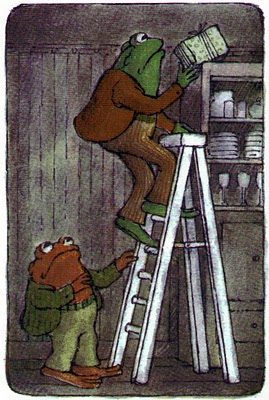
From "Frog and Toad"  by Arnold Lobel

From “Frog and Toad”
by Arnold Lobel

.

When you’re up high, let’s say on a ladder, people always tell you, don’t look down. But do me a favor, will you? Take a minute to glance over your shoulder. That’s right, look down the ladder the today. Here’s why . . .

When your sole focus is looking up the publishing ladder as you struggle to climb rung by rung, it’s easy to feel like you’ll never reach the top. But let me encourage you to hold the rung a second. Pause. Even for a moment. Stop craning your neck upward and turn. Look back down that ladder. You started at the bottom, maybe this year or maybe years ago. Now, see how far you’ve come!

Today, before you uncork some bubbly or sing that silly “Auld Lang Syne,” make a list–not a mental list, a REAL list on paper or screen–of all you’ve accomplished this year toward your writing goals. You have so much to be proud of. (I know, I should have said, You have so much of which to be proud, but that sounds kind of snooty for my purposes, and using proper grammar wasn’t one of my goals for 2013!)

Sure, there’s a lot more you want to do (same here), but treat yourself to a moment to appreciate how high you’ve already climbed. Take a deep breath. Enjoy the view!

My “rungs” for 2013 include:

January – Attending the annual SCBWI winter conference in New York City. Amazing!
February – Seeing my non-fiction article “Sculpting Lincoln” in Highlights for Children magazine.
March – Participating in a writers workshop at Vermont College of Fine Arts and receiving encouragement from incredible YA authors Cynthia Leitich Smith, Lauren Myracle and Candlewick editor Andrea Tompa.
July – Celebrating with my dear friend Kelly Barson on her debut novel “45 Pounds More or Less”–and being honored to be included in her acknowledgements page–a first for me!
November – Being selected to be part of the SCBWI – Eastern New York Falling Leaves master class workshop in Silver Bay, New York, and meeting five amazing edtiors, along with more than 30 encouraging writers.
December
– Enjoying another year of mutual support and feedback from my wonderful critique group (aka, Church of the Word!).
– Toasting the first anniversary of “Frog on a Dime.” I started with zero followers and now have 1,043. (Not record shattering, but hey, it’s progress.)
– Finishing through Lesson 8 of 9 in my Institute of Children’s Literature writing class. My second middle grade novel is almost done.
– Gathering ideas and details for my third middle grade novel that’s bubbling to the surface (Finally! Phew.) Exciting!

I’m wishing I could say my second novel is completely done. I’d like to say I have an agent and a two-book deal a publishing house. But those rungs are just ahead of me (fingers and toes crossed). I’ll be delighted to put those on my 2014 rung list.

What’s that? You say you submitted your work this year, but only have a stack of rejection letters to show for it? Well, that’s VERY rung-list worthy. (Honest. I’m not just saying that to give you something to put on your list.) You submitted your work (it’s virtually impossible to receive a letter of rejection otherwise!) You wrote, revised, researched publishers and took the leap to share your work for consideration. Okay, so you didn’t get the desired response, but you’re now ready to narrow your search and target new houses for submission in the new year. That’s great. Rung it up!

Happy New Year! Let’s “rung” it in together. Umquam porro. Ever forward, my friends. Ever forward. Rung by rung.

A poet is a man who puts up a ladder to a star and climbs it while playing a violin. ~ Edmond de Goncourt

and the birthday present goes to . . .

Standard

Happy first birthday,  Frog on a Dime!

Happy first birthday,
Frog on a Dime!

Congratulations to Jennifer Byrnes! Your name was selected in Frog on a Dime’s First Birthday Celebration Critique Giveaway. Jennifer, I will be in touch soon regarding the submission details for your free 10-page critique. I am truly looking forward to reading your work and doing what I can to help you make it even stronger.

Many thanks to all who entered the drawing, and to everyone who sent birthday wishes. You made me so “hoppy”! (Oh, c’mon. I can’t have a pun-less birthday!)

While I’m passing out gifts, and since it is the holiday season, I want to share my wishes for all of you . . .

I wish you the gift of laughter–even if it means laughing at yourself.
I wish you the gift of time to “be,” not do–just “be” for a moment and be mindful.
I wish you the gift of kindness–toward yourself especially. (We are our own worst critiques, aren’t we?)
I wish you the gift of inspiration from unexpected sources–and the presence of mind to write it down!
I wish you the gift of a tender, child-like heart–if even for a day, especially this time of year.

And now, if you’ll excuse me, I think I will give myself the gift of one more slice of birthday cake!

My mother asked me what I wanted for my birthday, so I said I wanted to read poetry with her. ~ Guy Johnson (author and Maya Angelou’s son)

happy first birthday, frog on a dime!

Standard

Happy birthday to you!

Happy birthday to you!

Starting a blog–the technical part–isn’t too difficult (especially when you have patient, tech savvy friends to help you), but actually launching the thing is scary. You’re putting yourself “out there.” What if everyone yawns and says, “What else ya got?”

As I shared right from post one, my intent for “Frog on a Dime” was never [cue dramatic music] total blogosphere domination. I just wanted to offer encouragement, inspiration and maybe some amusement to my fellow children’s writers. What a delight to see your response, and to go from zero to well over 1,000 followers this year. And so, it is with joy and humility (and yes, a bit of relief–phew! you showed up!) that I am celebrating the first full year of “Frog on a Dime.”

To be sure, the growing number of followers was a pleasant surprise. But the other thing I did not expect about my first blog experience was the way you all would become such a source of encouragement to me. What a bonus!

To thank you for reading and responding, I want to offer a special 1st birthday thank you gift–a FREE manuscript critique. Typically, I need to charge $45 for a critique, but I want to make it my gift to you. All you need to do is comment on this blog by midnight (EST) on Sunday, December 15 (Frog on a Dime’s actual birthday). I will draw a name and the winner will receive a ten-page critique of the picture book, middle grade or YA manuscript of your choice during the month of January. I can’t wait to read your work and do what I can to help you to become an even stronger writer!

Now . . . time to blow out the candles and make a wish! (Bet you can’t guess what that will be. And while I’m at it, I’ll make a wish for YOU too!)

It takes a long time to become young. ~ Pablo Picasso

merry muse-mas a la enid

Standard
Photo by Vicky Lorencen

Photo by Vicky Lorencen

My muse Enid goes to visit her mother in New Hampshire for the holidays, but before she goes, Enid always leaves me one of her “love notes” to keep my writing on track while she’s off slurping egg nog and chomping chestnuts.

This year is by no means an exception. Now that I have a blog, I thought I’d share some of Enid’s holiday goodies with you.

Photo by Vicky Lorencen

Photo by Vicky Lorencen

And so, without further fuss, here are my muse Enid’s Twelve Days of Revision:

Twas the night before deadline and all through the roost not a writer was sleeping, not even Proust.

(Sorry, that was the beginning to last year’s letter.)

Okay, off we go . . .

On the Twelve Days of Revision, my muse Enid said to me:

1. Snip-snip adverbs
2. Nix “very” and “really”–they really don’t add very much!
3. Keep tags simple (she implored with a heavy sigh)
4. Pinpoint POV for consistency
5. Pluck stuffy words–simple sings
6. Poo poo “start to”—just do the thing already!
7. Invigorate verbs
8. Specify specifics–no “thing” or “it”
9. Dice up long sentences
10. Juggle sentence structure
11. Extract “that”s–that’s about enough of that!
12. Read out loud (repeat)

After each round of revision, Enid recommends letting the manuscript “rest” for at least a few weeks so I can return to it with fresh eyes. (When she’s feeling cheeky, she says I should let the draft “ferment” a bit. What a sweetheart she is.) Snarky or sweet, Enid is right about writing. I can just hear her now–“I always am, my dear. I always am.”

Merry revisions to you all!

Following my muse has worked out pretty well so far. I can’t see any reason to change the formula now. ~ Chris Van Allsburg

how to magnitude your gratitude (dude)

Standard

Photo by Vicky Lorencen

Photo by Vicky Lorencen

I love words. Wipe that shocked expression off your face, you silly. You know I do.

This week I found out the word gratitude comes from the Latin word gratia, which means grace, graciousness or gratefulness. To me, grace means receiving something I don’t deserve–it’s that open-hearted expression of forgiveness, the kindness for which I’m unqualified and the willingness to overlook my writer-related neuroses (note the plural). That’s grace to me. And I’m grateful for every little bit I get.

Besides discovering the root of the word gratitude, I also learned from the Harvard Mental Health Newsletter that expressing thanks is strongly and consistently associated with greater happiness (and they have the research to back it up). Gratitude helps us to cultivate positive emotions, relish (and notice!) good experiences, improve our health, deal with the crappy stuff and build strong relationships. KA-pow! Gratitude is powerful.

What was of particular interest to me as a writer was that the researchers at the University of California and the University of Miami used writing exercises to gauge the impact of gratefulness. For example, one group of study participants was asked to keep a log of things they were grateful for over the course of a week. A second group got to list the stuffed that bugged them as the week progressed. The 10-week study not only showed that grateful people felt more optimistic–they were more physically healthy too.

When another group was challenged to write and hand deliver a letter of gratitude to someone who had never been properly thanked for his or her kindness, participants immediately experienced a huge hike in their happiness scores. And these benefits lasted for a month. (That’s better than chocolate!)

Photo by Vicky Lorencen

Photo by Vicky Lorencen

And now [cue drum roll] two sure-fire ways to write your way to happiness and better health . . .

Okay, okay. I know what you’re thinking. This is starting to sound like an infomerical for a self-help seminar or something. Not to worry. I’m sharing these ideas because, well, we writers are not always the most healthy people–physically or emotionally. We get discouraged and depressed. We fret. We are self-critical. And we sit on our bums a lot writing. Our bods and our brains could use a boost, wouldn’t you say? So try these ideas . . . (C’mon. You can do it!)

Write. Send. Repeat. Send someone a good old-fashioned written thank you note. Not an email. Not a text. A “real” note scribed with your own sweet little grabber. Don’t wait for someone to do something nice or give you a present. Pick a person you appreciate and then write to tell them why. It’s that simple. You will feel good and they will feel great. Why, you’ll knock their stinkin’ socks off! Your words carry positive energy. (Who knows, researchers may learn they contain fiber and anti-oxidants too!) Write and send a thank you note once a month. Pick a date you’ll remember–pay-day, your birthday or whatever, and then make it a habit.

Journal Good Stuff. Start by writing down three things you’re thankful for. It can be ANYTHING–the barista made my coffee just the way I like it, I got to work on my favorite writing project this week, my allergies aren’t acting up. You can build from there. Add one more thing each week. As the weeks progress, you’ll be more mindful of the good stuff and be excited to add it to your list. Bonus benefit–because you are cataloging these positive things, you can go back and reread your list for encouragement when life feels sucky. So, there’s that.

And just so you know. I’m grateful for you. No, really I mean it. Now stop reading this silly blog and go find a pen and paper before you get distracted. You’ll thank yourself for it.

Let us be grateful to the people who make us happy; they are the charming gardeners who make our souls blossom. ~ Marcel Proust